


Traditionally, the brokerage industry has focused heavily on acquisition. Brokers invest significant resources in advertising, affiliates, IBs, technology, promotions and onboarding, all with the goal of converting prospects into funded accounts.
But acquisition is only the beginning of the equation. The return on that investment becomes clear over time, as traders develop their relationship with the broker and generate ongoing business value.
So what happens after the first deposit (FTD), and how can brokers increase the long-term value of the clients they acquire?
Our analysis of trading behaviour across multiple brokers points to an opportunity to further develop retention strategies and improve the return on acquisition.
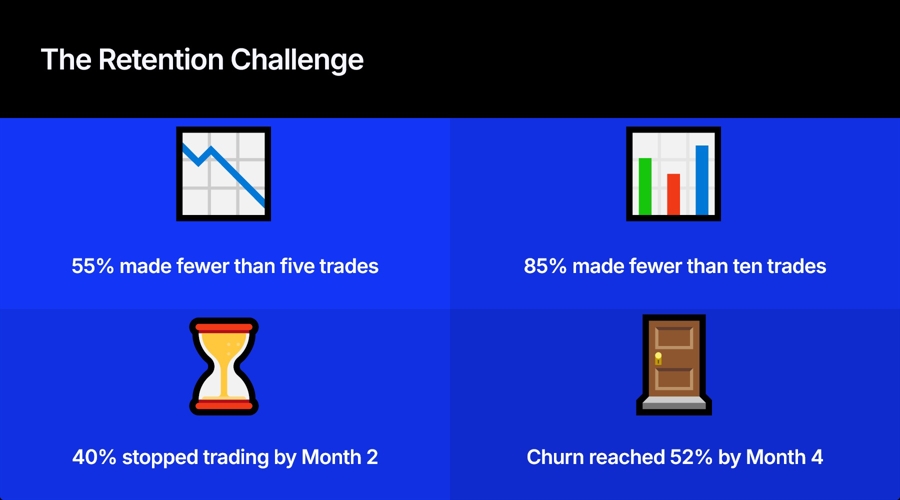
In data collected between June and August 2026, approximately 55% of funded accounts made fewer than five trades per month. In several broker datasets, the proportion of accounts making fewer than ten trades per month reached 75–85%, based on several samples of more than 1,500 accounts.
We also found that monthly inactivity and churn can reach 50% in some cases, reflecting the drop in users from one month to the next.
The picture becomes even clearer when looking at individual cohorts. In one dataset from a large regulated broker, involving more than 10,000 accounts, 40% of traders who were active in the first month were no longer trading in the second month. By the fourth month, the cumulative figure had reached 52%.
These findings highlight an important aspect of brokerage economics: a funded account is often treated as a successful conversion. However, whether that account develops into an active, long-term client has a direct impact on the return on acquisition. This means that FTD and FTD size may not be the sole indicators of a successful conversion.
Acquiring a trader and developing that relationship into sustainable business value are two different stages of the same process. The full ROI of acquisition could therefore be revealed over time.
Every broker has a different business model, client profile and approach to retention. Some generate a significant part of their revenue from a relatively small number of highly active or high-value clients. Nevertheless, the broader client base represents an opportunity to develop additional value over the lifetime of each relationship.
Individual Differences
Our analysis of trader behaviour suggests that marketing and promotions, while important components of retention, do not always address the individual factors that influence a trader’s decision to continue, slow down or disengage. There can be many reasons for a decline in trading activity. One common behavioural factor is fear of loss.
A trader who experiences early losses after the FTD may naturally become hesitant, lose confidence or begin questioning their ability to trade. Even when the trader remains interested in the markets, this experience can create a barrier to further activity.
Less experienced traders may be particularly sensitive to early losses. Day trading is a skill that develops over time. It involves learning to deal with uncertainty, understanding personal reactions to gains and losses, and developing a consistent approach.
The technologies and AI capabilities available in the industry today are remarkable. Brokers use them across multiple stages of the client journey. Marketing campaigns, bonuses, promotions, automated messages, AI diallers and account manager calls all have a role in maintaining contact, providing incentives and encouraging activity.
However, different traders have different needs and respond to different forms of support. Traders with similar account balances, trading histories and economic potential can behave very differently. One may benefit from more human connection, another from a better understanding of their own trading behaviour, while a third may simply have lost interest.
Understanding these differences creates an opportunity to make retention activities more accurate and effective.
Understanding Behaviour Can Change the Equation
At CPattern, our AI-supported research helps us identify behavioural patterns, test hypotheses and examine how different types of trader engagement relate to business outcomes.
One important principle emerging from this work is that LTV is not created through a single transaction, promotion or follow-up. It develops over time, through an ongoing relationship with the trader and a series of relevant interactions that support continued engagement. This requires a consistent approach rather than isolated retention efforts.
In comparisons conducted across more than ten brokers between 2021 and 2026, we examined the performance of traders receiving personalised real-time feedback against relevant benchmark groups.
In one case involving more than 1,000 accounts, the benchmark group showed a churn rate of 52%, compared with 25.3% among traders receiving the support. That represents a reduction in churn of approximately 51% relative to the benchmark.
We also observed higher trading activity, trading volume and re-deposit levels among the supported traders.
These results do not mean that every trader will respond in the same way, or that one intervention will solve every retention challenge. They do, however, suggest that ongoing, systematic feedback, delivered in a relevant context and at the right time, can improve resilience and make a meaningful contribution to trader engagement and business performance.
This is where personalisation becomes more than a marketing feature: it creates an opportunity to support the development of a longer-term relationship between the trader and the broker, while helping build trust, confidence, discipline and stability.
A Proactive, Preventative Approach to Retention
Retention strategies can benefit from moving beyond reactive interventions. Contacting a trader after a significant decline in activity or following a margin call is sometimes necessary, but it often means responding after a problem has already developed.
A more proactive approach, based on ongoing engagement and timely, relevant feedback, creates an opportunity to support the trader earlier in the journey.
This also has an economic dimension: the cost of acquiring a new trader has already been invested, and developing the value of that relationship over time can improve the return on the original acquisition investment.
Retention tools should therefore be evaluated not only by their immediate effect (e.g. the time taken to open the next trade), but also by their contribution to longer-term engagement, survival and overall client value.
Technology now makes it possible to move beyond retention campaigns and introduce a more continuous, personalised approach to trader engagement. Ultimately, sustainable brokerage growth depends not only on how effectively new clients are acquired, but also on how successfully their value is developed over time.
Acquisition brings traders into the business, and the ongoing relationship is what determines the long-term value of that investment.
This article was written by Oded Shefer at www.financemagnates.com.Retail FXRead More
You might also be interested in reading Ethereum Price Flashes Weakness Signals, Pullback Fears Start Rising.