


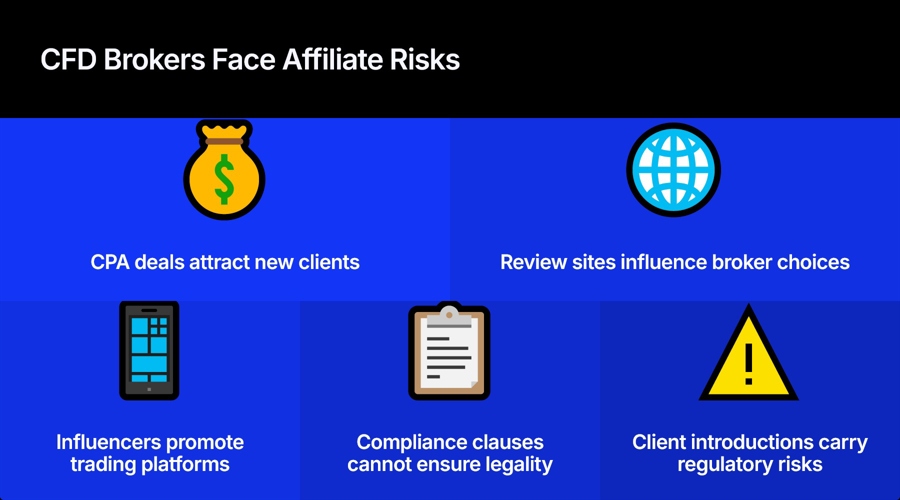
For years, CFD brokers have treated customer acquisition as a department they can outsource. The process was simple: find an affiliate with traffic; agree on a CPA; send a tracking link; and celebrate the FTDs.
It is the responsibility of marketing to get the leads, while sales get the deposits. Compliance’s responsibility is to get an agreement.
The arrangement works well until a regulator asks who brought the customer, what they promised, and whether they were entitled to make that introduction.
London’s trading industry is coming home!
Interestingly, the gambling industry serves as a warning against this customer acquisition practice by CFD brokers, while Europe leaves a regulatory gap. The UAE, meanwhile, shows what closing this gap looks like.
Gambling Is Bigger. The Regulatory Problem Is Familiar.
H2 Gambling Capital estimates that global gambling generated $758 billion in gross gaming revenue in 2025, including $327 billion online. It expects the industry to cross $1 trillion by 2030.
CFD brokerage is much smaller and harder to size. Two Dataintelo reports estimate 2025 global CFD brokerage revenue at $8.46 billion and $12 billion, respectively. Those studies use different definitions. Neither is an audited industry total, and gambling gross gaming revenue is not exactly the same accounting measure as broker revenue.
Still, we are talking about very different scales. And comparing CFD notional trading volume with gambling revenue would be nonsense.
What makes the comparison useful is not size. It’s the acquisition model: offshore operators, affiliate commissions, review sites, paid rankings and promoters operating across borders.
Gambling Regulators Are Coming for the Middleman
Romania has required certain gambling affiliates to hold Class II licences for years. Annual statutory charges include a €20,000 licence fee and a €15,000 responsible-gambling contribution, plus a €10,500 initial issuance fee.
In March 2026, Romania’s gambling regulator, ONJN, filed a criminal complaint against a licensed affiliate accused of redirecting Romanian users to unlicensed gambling platforms. That is an allegation, not a conviction. But the target was the affiliate, not just the operator.
Finland is taking a different route. When its licensed online gambling market opens on 1 July 2027, independent affiliate and influencer marketing will remain outside the permitted channels.
Although the mechanics of the CFD industry are different, the question remains the same: why regulate the operator and leave the person delivering its customers largely uncontrolled?
Europe Already Has Tied Agents. But Look at What’s Outside That Structure.
We should acknowledge something that often gets missed in these conversations.
Under MiFID II, which has applied since 3 January 2018, investment firms can appoint registered tied agents to promote services, solicit business and perform certain other activities on their behalf. The broker remains fully responsible for the tied agent. That is not a new regulatory invention as the tied-agent concept actually predates MiFID II.
But here is the distinction.
A comparison website publishing broker rankings is not automatically a tied agent. Neither is a news publisher running sponsored articles, a review website collecting CPA commissions or an influencer discussing platforms.
They don’t get a free pass, either.
Whether those businesses cross into regulated solicitation, investment advice or other restricted activity depends on what they actually do and the law of the country concerned. Spain and Portugal already impose stricter conditions on affiliate-led acquisition.
ESMA itself highlighted paid comparison sites, affiliate links and sponsored financial articles in a 2023 discussion paper. Its concern was straightforward: what looks like independent information may actually be paid distribution. Firms should monitor their affiliates’ marketing communications.
That is where the next regulatory battle sits. Not with the registered tied agent everyone can identify. With the websites, publishers, content creators and lead generators operating between ordinary advertising and client solicitation.
The UAE Has Already Drawn a Harder Line
In Circular No. 1/2024, the UAE’s Securities and Commodities Authority, now the Capital Market Authority (CMA), told licensed firms to stop contracting with unlicensed individuals or companies to solicit clients.
The regulator classified that solicitation as licensed introducing activity and instructed firms to terminate non-compliant arrangements.
The UAE also introduced financial-influencer registration requirements in 2025.
That does not mean every advertisement requires an introducing licence. Nor does the federal CMA framework replace the separate rules of DIFC and ADGM.
But the commercial principle is unmistakable: when customer acquisition becomes regulated introducing activity, a CPA contract does not make the introducer legal.
Europe Is Tightening Enforcement Without Waiting for Another Licence
The UK’s FCA has specifically identified firms that use and pay unauthorised affiliates to introduce CFD clients as a regulatory concern.
In April 2026, the FCA led action with 17 regulators. In the UK, it requested the removal of 120 social media accounts and identified 1,267 illegal financial advertisements reaching at least 2.3 million UK accounts.
ESMA’s January 2026 finfluencer guidance reinforced that investment advice does not become harmless because someone adds “not financial advice” to a video.
Google is tightening distribution, too. From July 2026, it expanded financial-services advertiser verification to 24 more EEA markets. For in-scope financial advertising, certain third parties without their own regulatory authorisation must have an eligible authorised advertiser apply for verification on their behalf.
You may be willing to pay for traffic and still be unable to buy it.
The Risk Is Already in Your Affiliate Database
I know how the conversation usually goes inside a brokerage. How many FTDs? What CPA? What’s the lifetime value? Can they scale?
These are fair questions. But who controls the landing page? Is that “independent” review paid for? Who wrote the influencer’s script? Which markets is the Telegram group targeting? Is the partner only publishing an advertisement or actively soliciting a customer?
A signed compliance clause cannot answer those questions.
I am not predicting that Europe will copy Romania’s gambling licence or that every review website will need to become a tied agent. That would be legally careless.
I am saying the space between licensed financial distribution and commercially paid “independent” content is becoming harder to defend.
Europe has had tied agents for years. The UAE has made licensed introducing a frontline issue. Gambling shows what happens when regulators decide the middleman is part of the regulated business.
The next compliance problem for CFD brokers may not be the leverage they offer. It may be the people they pay to bring in the clients.
This article was written by Badea Alexandru Gabriel at www.financemagnates.com.Retail FXRead More
You might also be interested in reading XRP Rich-List Unfolds Crucial Shift Among Top Holders.