


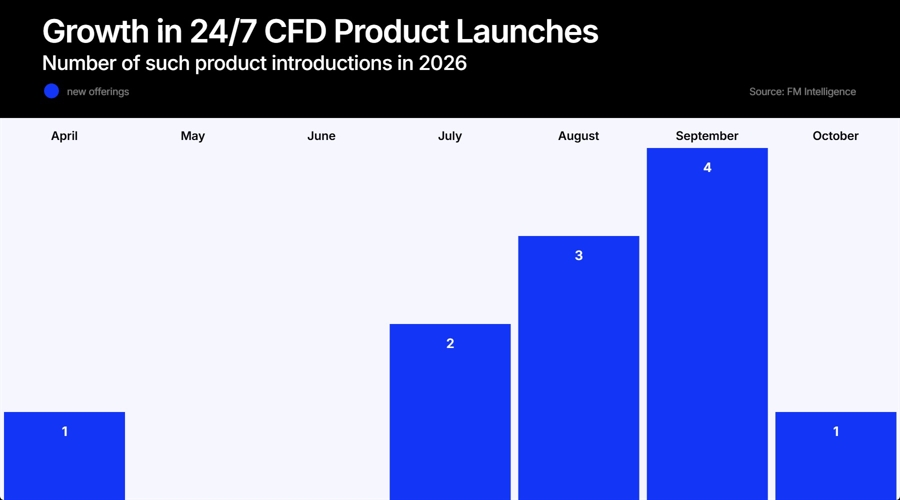
The traditional five-day trading week is coming under increasing pressure. Throughout 2026, a growing number of FX/CFD brokers have introduced products that allow clients to trade seven days a week, including weekends when most underlying financial markets remain closed.
Gold has become the main focus of this expansion, with Vantage, VT Markets, XM, STARTRADER, CFI Financial Group and CMC Markets among the brokers introducing weekend trading. Others, including FxPro and easyMarkets, have extended the offering to oil, silver and selected equity indices.
However, keeping a trading platform open is relatively straightforward compared with the more complicated task of providing reliable prices, sufficient liquidity and effective risk management throughout the weekend.
London’s trading industry is coming home!
Benefits and Risks of 24/7 Trading
For retail traders, the main attraction is flexibility. Financial markets are increasingly influenced by events that do not follow traditional trading hours. Geopolitical developments, elections, military conflicts and unexpected policy announcements can occur on Saturdays and Sundays, leaving investors unable to respond through conventional instruments until markets reopen.
Weekend CFDs allow traders to react immediately, potentially hedge existing positions or speculate on how prices will respond when regular trading resumes.
Meanwhile, continuous trading creates for brokers an opportunity to increase client activity, attract new customers and compete with cryptocurrency exchanges and prediction markets that already operate throughout the weekend. Liquidity providers also see a commercial opportunity, as brokers need new pricing feeds and execution services to support these products.
The trade-off between continuous access and market infrastructure
Source: Finance Magnates Intelligence (based on FIA and CFTC)
In its March 2026 roundtable report, the Futures Industry Association (FIA) highlighted growing demand from both retail and institutional investors. Coinbase’s Liz Martin noted that its futures exchange regularly experiences billion-dollar weekend trading days, while Marex’s Thomas Texier pointed to increasing interest from asset managers and corporations seeking to manage risk before Monday’s opening.
However, greater accessibility does not necessarily mean better trading conditions. Weekend liquidity may be considerably thinner than during conventional sessions, resulting in wider spreads, greater price volatility and potentially more expensive execution.
There is also a fundamental difference between trading an instrument on an established exchange and trading a synthetic CFD whose price is determined by a broker or liquidity provider. In the latter case, the trader may be exposed to prices that do not fully reflect those available when the underlying market reopens.
Pricing and Hedging: Key Weekend Trading Challenges
One of the biggest questions surrounding 24/7 CFDs is what happens when a trader opens a position while the underlying market is closed. During conventional trading hours, a liquidity provider can use spot markets, futures or other derivatives to hedge its exposure. However, when major exchanges close for the weekend, those options become limited. The broker or liquidity provider must either find an alternative market, offset opposing client positions or retain some of the exposure until conventional trading resumes.
Learn more about the challenges of pricing and hedging, and how the industry is addressing them, in our full analysis on the Finance Magnates Intelligence portal.
This article was written by Sylwester Majewski at www.financemagnates.com.ProductsRead More
You might also be interested in reading Kospi Falls Below 5,600 in Record Back-to-Back Circuit Breaker as Bitcoin Rises Above $64,000.