


The retail trading industry saw developments across regulation, market access, acquisitions and customer acquisition this week. IG Group moved closer to offering prediction markets in the UK, while Plus500 agreed to buy a Brazilian broker as it continued expanding its multi-asset business.
Google also revised its advertising policy for contracts for difference in two markets, potentially reopening access to paid search campaigns for eligible providers.
London’s trading industry is coming home!
Elsewhere, salary data highlighted differences between financial centres, while Capital.com’s trading figures offered insight into client behaviour. Prop trading, institutional access to prediction markets and the economics of broker marketing also featured in the week’s developments.
In digital assets, new figures highlighted the gap between the growth of tokenised real-world asset ownership and the trading activity needed to support liquid secondary markets.
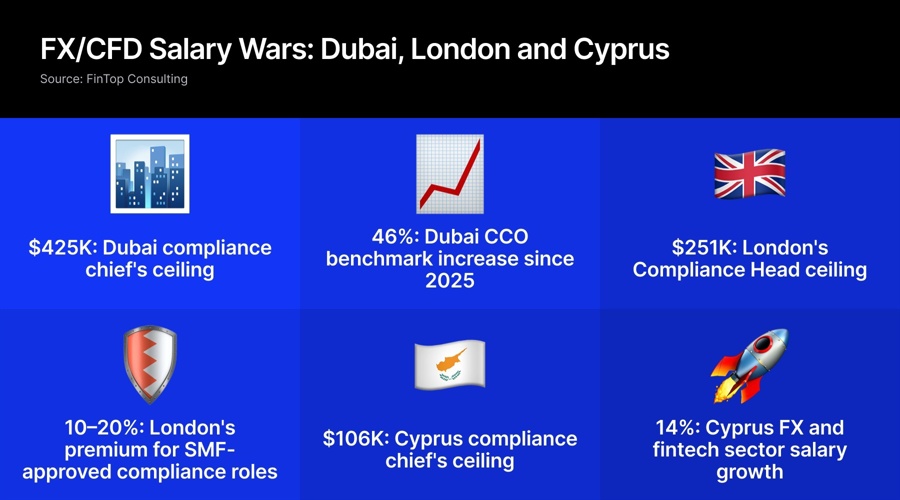
Dubai Compliance Chiefs Earn Up to $425K as Cyprus FX Salaries Rise 14%
FinTop Consulting’s 2026 salary surveys showed substantial differences in compensation across Dubai, London and Cyprus. Dubai-based Chief Compliance Officers can earn between $310,000 and $425,000 annually, with the lower benchmark matching the upper salary benchmark for Chief Technology Officers.
London Heads of Compliance can earn up to $251,000, while regulatory specialists handling additional responsibilities command premiums of 10% to 20%.
Cyprus recorded annual salary growth of 14% across its foreign exchange and fintech sectors, compared with approximately 4% across UAE financial services. The figures point to differing compensation trends across the three financial centres.
Dubai’s compliance salaries also exceed those available for several commercial executive roles, although some technology and risk positions can command higher maximum pay.
IG Applies for UK Gambling Licence to Offer Prediction Markets
IG Group has applied for a UK gambling licence to offer prediction markets covering sports, politics and entertainment, with a launch planned for early 2027.
The application was submitted through its London subsidiary, IG View Limited, which appears on the Gambling Commission’s register under the trading name ig prediction markets.
The application remains pending, and the licence has not been granted.
The company also plans to introduce financial event contracts for UK professional clients in the fourth quarter of 2026. Its expansion follows an agreement to acquire US fantasy sports and prediction markets operator Underdog for up to approximately $1.3 billion.
The deal is expected to close in late 2026 or early 2027. IG’s plans would extend its offering beyond conventional leveraged trading products.
Capital.com UAE Clients Trade $1 Trillion
Capital.com clients in the United Arab Emirates traded $1.06 trillion during the first half of 2026, accounting for more than two-fifths of the broker’s $2.45 trillion in total trading volume.
UAE trading volume increased 27.7% from the second half of 2025, while closed trades rose 48% to 80.9 million, according to the broker’s H1 2026 Pulse Report.
However, only 18.3% of UAE trades had a stop-loss set, the lowest proportion among seven markets covered. Germany recorded the highest rate at 34.1%, followed by the Netherlands at 32.8%.
Across Capital.com, 22.4% of closed trades carried a stop-loss set at entry. The report also found that positions closed after a stop-loss trigger recorded 39% lower average losses, although it described this as a correlation rather than proof of causation.
Hantec Trader Rebrands as RZR Funded
Hantec Trader, the proprietary trading business within the Hantec Group, has rebranded as RZR Funded and changed the name of its operating company from Hantec Trader Limited to RZR Funded Limited. The firm said the change establishes a separate identity for its prop trading operations as it prepares for further development.
The business remains part of the Hantec Group and continues to be powered by Hantec Markets Mauritius, the group’s retail broker arm regulated by the Financial Services Commission.
RZR Funded Director Bashaar Gokal said the company was expanding its executive team and preparing to introduce new asset classes and trading tools. He added that existing traders should not expect immediate operational changes as a result of the rebrand.
Google Reopens CFD Advertising in Denmark and Chile
Google has updated its policy on complex speculative financial products to permit advertising for CFDs, rolling spot forex and similar products in Denmark and Chile. The changes take effect in October, although Google has not specified an exact date.
Advertisers in Denmark must hold the relevant authorisation from the Danish Financial Supervisory Authority, while providers in Chile must be registered with and authorised by the Financial Market Commission or the Central Bank of Chile, depending on the products offered.
Advertisers must also meet applicable local legal requirements and obtain Google certification. The revised policy creates an opportunity for eligible brokers to advertise these products through Google in both markets. Google said violations would trigger a warning at least seven days before any account suspension.
Kalshi Targets Broker Distribution
Kalshi is seeking to expand access to its event contracts through brokerage platforms, with liquidity central to its pitch to financial services firms. In an interview with Finance Magnates, Andy Ross, the exchange’s Head of Institutional, said connecting brokers to an existing venue allows them to access a shared order book rather than build their own exchange and clearing infrastructure.
Kalshi has already launched an API-based service with Apex Fintech Solutions, allowing brokers to integrate its contracts into their platforms. Tastytrade was the first broker to go live. Ross said firms onboarding to or already trading on Kalshi collectively manage more than $1 trillion in assets.
The exchange is also preparing to launch perpetual futures linked to foreign exchange markets and offers market data to firms that do not trade its contracts directly.
Plus500 Agrees to Acquire Brazilian Broker Guru
Plus500 has conditionally agreed to acquire full ownership of Guru Corretora de Títulos e Valores Mobiliários Ltd, a regulated Brazilian broker-dealer.
The London-listed group said the transaction would be funded from its existing cash resources, which exceeded $860 million.
The acquisition gives Plus500 access to local licences from Brazil’s Securities and Exchange Commission and Central Bank of Brazil. These authorisations would allow it to expand its domestic offering to Brazilian shares, futures, options and fixed-income securities.
Chief Executive David Zruia said the deal provides the licences, local team and regulatory framework needed to operate in the market. The agreement follows Plus500’s acquisition of US broker-dealer Hedge, which is intended to support its planned US multi-asset platform.
Brokers Face Pressure as CPA Rates Outpace Initial Deposits
Customer acquisition costs are putting pressure on forex and CFD brokers as cost-per-acquisition payments increasingly exceed clients’ initial deposits. Anish Lal, Chief Business Development Officer at BlackBull Markets, noted that brokers may pay $800 to acquire a client who makes an initial deposit of $400 to $500.
They must then rely on further deposits and trading activity over the following six to 12 months to recover the expense. If the client leaves after one or two months, the acquisition becomes loss-making.
Lal argued that brokers do not necessarily need to match the highest CPA rates to attract introducing brokers. Faster reporting, reliable monthly payments, dedicated support and stronger client retention can provide alternatives to higher upfront payments.
CFD Brokers Are Reassessing Marketing Strategies as First Deposits Fall
CFD brokers are facing declining numbers of first-time depositors and rising acquisition costs, prompting some to reconsider their marketing teams and external agencies. Alexandru Badea, Senior Regional Director at NAGA, argued that changing personnel may not solve the problem if companies continue relying on incomplete data and outdated assumptions.
Advertising platforms such as Google, Meta, TikTok and LinkedIn have changed their algorithms, affecting campaign performance. Badea said brokers need to connect marketing information with onboarding, verification, deposits and client retention to identify where potential customers drop out.
Comparing acquisition sources by the quality and longevity of the clients they generate can help distinguish inexpensive registrations from valuable customers. The article emphasised data analysis over repeatedly changing marketing teams.
Tokenised Real-World Assets Gain Holders but Struggle to Generate Trading
Anndy Lian argues that tokenised real-world assets continue to attract holders, but secondary-market activity remains limited across much of the sector. Pantera Capital’s September 2026 report surveyed 671 tokenised assets worth a combined $331.8 billion.
Permissioned products accounted for 59% of market capitalisation but generated just 0.2% of spot trading volume. More than half of the analysed market showed no meaningful secondary trading activity.
Holder numbers are growing, with BNB Chain exceeding two million RWA holder addresses in early October. However, only 29 of 110 major tokenised products met basic thresholds for both liquidity and distribution.
Tokenised stocks recorded monthly turnover of 204.6%, compared with just 0.1% for tokenised rate products. Lian highlights the need for market makers, regulatory clarity and connected trading venues to support sustained activity.
This article was written by Tareq Sikder at www.financemagnates.com.Retail FXRead More
You might also be interested in reading $510M longs at risk if Ether repeats last weekend’s volatility.