


The CPA model has long been one of the most direct ways for brokers to acquire clients and introducer books. It is simple, trackable, and commercially clear: pay a fixed amount for a qualified client, then aim to recover that cost through spreads, commissions, and lifetime value. In theory, this aligns interests. In practice, the model is under increasing strain.
London’s trading industry is coming home!
CPA Costs and Acquisition Losses
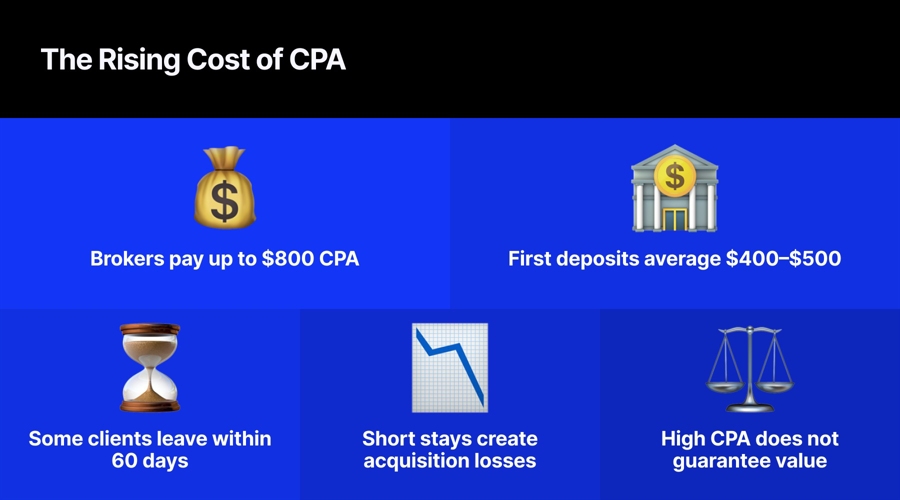
In many markets, advertised or privately negotiated CPAs now routinely exceed the average initial deposit. A broker may pay an $800 CPA for a client whose average first deposit is $400–$500, accepting an immediate loss on the assumption that the client will deposit again and generate enough activity over 6–12 months to recover the cost.
If that client churns after one or two months, the acquisition is loss-making.
Some brokers are prepared to run these early losses as a deliberate strategy to lock in introducers and build scale. Others go further, showing a longer tolerance for CPA abuse, such as multiple accounts, self-referrals, or low-quality traffic, because they prioritise volume or believe the economics still work at portfolio level. This raises a straightforward question: where is the sustainable value?
Client Quality and Introducer Retention
Two introducers can deliver similar volumes yet produce very different outcomes. One sends clients who deposit $1,000 on average and remain active for 8–10 months; the other sends clients who deposit $300 and largely disappear within 60 days.
Even if both are paid the same CPA, the first book is far more valuable. Brokers that can identify and retain higher-quality introducers create residual value. Those that compete only on the headline CPA rate often end up paying the same amount for markedly weaker economics.
Some firms accept a longer tolerance for abuse because they need the volume to support other commercial goals or have the balance sheet to absorb a higher proportion of short-lived clients. That approach can succeed for a time. It becomes harder to sustain once competitors match the rates and the quality of the books being acquired begins to decline.
At that point, the advantage shifts to brokers that can show introducers something other than the highest possible CPA. A broker that does not match the top market CPA can still win an introducer’s preference by offering faster and more transparent reporting, reliable monthly payments, dedicated support, and a platform that clients do not leave.
Managing CPA Costs and Long-Term Value
The introducer accepts a lower headline CPA because the overall commercial relationship and client retention are stronger. Over time, that broker retains more of the value created by the book. Competing on pure CPA alone is increasingly difficult. The more durable approach is to treat the CPA as one component of a broader commercial relationship rather than the sole lever.
Brokers that invest in the quality of the client experience, maintain disciplined filters on traffic, and are willing to walk away from books that only work at unsustainable acquisition costs tend to keep more of the value they create.
Those that rely primarily on outbidding others for volume often find that the books they acquire become less valuable over time, even as the cost of acquiring them continues to rise. The CPA model is not broken.
It remains one of the cleanest ways to reward introducers for performance. But the firms that extract lasting value from it are those that treat it as a measured commercial tool rather than an open-ended arms race.
In a market where many are prepared to run losses to secure books, the competitive edge increasingly belongs to those who know which losses are worth taking and which are not.
This article was written by Anish Lal at www.financemagnates.com.Retail FXRead More
You might also be interested in reading AstraZeneca plans to invest $50B in U.S. by 2030.