


In 1927, Austrian director Fritz Lang had cinema audiences freaking out over his portrayal of a futuristic city in the film Metropolis, where industrial technology dominates society and workers are effectively enslaved by the machines. Almost exactly a century later, President Trump is telling Americans that recent concerns over the potential impact of AI on the future of the human race are nothing more than a hoax designed to push through greater regulation.
As the above example highlights, this is not a new debate. In 2003, a paper published by Nick Bostrom (a philosopher known for his work on existential risk) warned that if we are going to create something that is much more intelligent than we are, we had better ensure its objectives are aligned with those of humanity.
Dario Amodei, chief executive of Anthropic, has consistently worked to establish his organisation as a gatekeeper for AI safety. Recently, he sought to reinforce that position in a blog post advocating a deceleration in the rate of advancement in AI model capabilities.
Amodei’s statement (and his observation earlier this year that AI represents a serious civilisational challenge) followed the recent resignation of Jacob Coxon, a former researcher at Anthropic, who raised concerns that both OpenAI and his former employer are not operating responsibly.
Former Anthropic employee Jacob Coxon says the AI industry is “gambling with our lives.” He tells Anderson what he finds “most scary is if AI is used to make itself more intelligent” and warns these companies are “compelled to race toward building a deadly technology.” pic.twitter.com/UFrLWVm0xD
— Anderson Cooper 360° (@AC360) September 10, 2026
A Real Alarm or Careful Marketing?
So how should these dire predictions be interpreted? Critics argue they represent a calculated marketing strategy designed to amplify the significance of cutting-edge AI technology ahead of potential public offerings by Anthropic and OpenAI.
A cynical observer may note that Amodei’s proposal for a mutually agreed-upon framework that preserves leading developers’ competitive edge – supported by OpenAI CEO Sam Altman, Elon Musk and Demis Hassabis, head of Google DeepMind – may be a strategy to influence regulatory frameworks in ways that favour their organisations.
Dario is right https://t.co/EwKgqQGaUo
— Elon Musk (@elonmusk) September 12, 2026
Retail traders looking to capitalise on AI market growth would be well advised to be much more selective than simply buying the obvious AI stocks. The AI trade has become crowded, and this week’s sell-off is a good illustration: semiconductor stocks were hit hard as investors reassessed the sustainability of AI spending.
Semiconductor ETFs are possibly the best risk-adjusted AI trade. Rather than trying to pick the eventual winner between Nvidia, AMD, Broadcom, Micron and others, an ETF gives traders exposure to the semiconductor ecosystem. SMH (VanEck Semiconductor ETF) and SOXX (iShares Semiconductor ETF) are obvious examples.
This is particularly attractive because AI spending isn’t just going into GPUs – it is flowing through memory, networking, foundries, semiconductor equipment and custom accelerators. VanEck notes that the semiconductor opportunity has broadened considerably as AI infrastructure develops.
The catch is valuation and concentration. Semiconductor ETFs can fall very quickly when AI capex expectations change (SMH fell almost 6% on Monday alone).
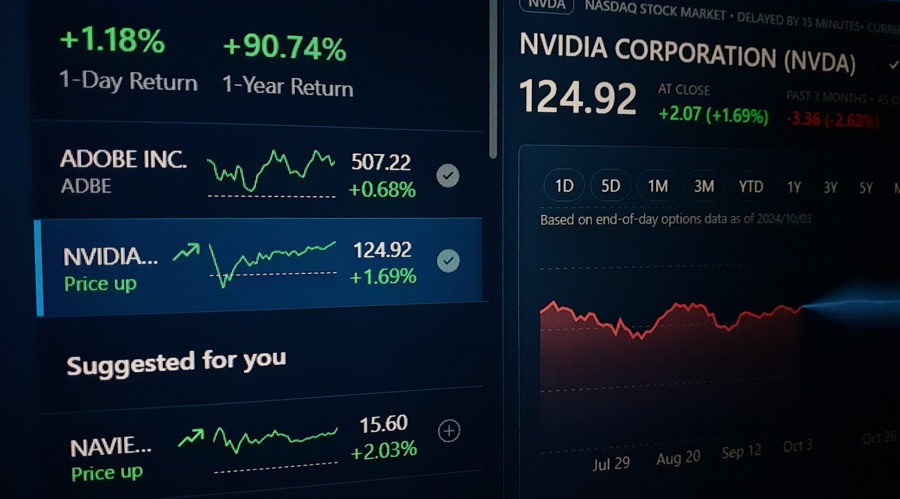
Nvidia remains arguably the most direct way to participate in the AI infrastructure build-out but it isn’t necessarily low risk.
Read more: Claude Powers Nine of Ten Broker AI Agents That Now Trade Live Accounts
A Broadening Market with Demand Risk Ahead
The interesting development now is that the AI semiconductor market is broadening. Broadcom, for example, is benefiting from hyperscalers developing their own custom AI chips. Morningstar describes Broadcom as Nvidia’s key secondary AI compute vendor as hyperscalers seek greater control over their silicon.
That makes a basket such as Nvidia, Broadcom, Taiwan Semiconductor Manufacturing Company and Micron Technology more interesting than simply making a huge Nvidia bet.
Broadcom is particularly intriguing because it sits in several parts of the AI infrastructure chain. The attraction is its exposure to custom AI accelerators, networking and the infrastructure required to connect enormous AI computing clusters.
AI power infrastructure is potentially the most interesting second-order AI opportunity. AI requires enormous quantities of electricity and data centre infrastructure, meaning the investment opportunity extends into areas such as electricity generation, nuclear power, transmission, transformers, electrical equipment and data centre construction.
VanEck’s AI infrastructure research explicitly identifies power as an emerging bottleneck and highlights nuclear, utilities and grid infrastructure alongside semiconductors.
There are now ETFs specifically targeting this theme, including AI infrastructure funds that invest in energy, grid equipment, data centres and materials rather than simply AI software. This is particularly attractive for traders who believe AI adoption will continue but think the semiconductor trade has become too expensive.
Elon Musk is warning about an “exponentially increasing risk” from artificial intelligence and calling on major tech competitors to test and peer-review one another’s security models.Speaking at the All-In Summit in Los Angeles, the Tesla and SpaceX CEO echoed growing concerns… pic.twitter.com/iYcuDiemFn
— Fox News (@FoxNews) September 15, 2026
Follow the Money
The ‘AI monetisation’ trade is a different proposition in that, rather than betting on who manufactures the AI infrastructure, it is taking a position on who ultimately makes money from it.
The major hyperscalers are spending extraordinary sums on AI infrastructure. Goldman estimates that Meta, Microsoft, Amazon and Alphabet could collectively spend $5.3 trillion in capex between 2025 and 2030.
These companies have enormous existing businesses that can fund AI investment, which is important because AI doesn’t necessarily have to produce spectacular standalone revenue immediately for these companies to benefit.
AI cybersecurity is an interesting contrarian angle. This week’s market rotation saw investors become more concerned about the risks of rapidly advancing AI. Cybersecurity companies such as CrowdStrike and Palo Alto Networks actually benefited from the rotation, while Nvidia and other infrastructure names were hit.
Companies providing AI security, identity and endpoint protection, plus cloud security, could benefit whether AI development accelerates or becomes more regulated. However, there are a few strategies that could provide less than profitable.
There has been a proliferation of leveraged and single stock ETFs in 2026. More than 1,000 ETFs have launched in the US this year – including numerous leveraged/inverse and single stock products – which can be extremely dangerous for someone trying to hold an AI theme for several years.
The AI opportunity may be enormous, while AI stocks simultaneously become poor investments because expectations are already priced in. There is already evidence of concern that AI capex is growing faster than AI revenue.
Finally, traders would also do well to be wary of companies whose investment case is essentially ‘AI is going to transform the world, therefore our share price should rise’.
This article was written by Paul Golden at www.financemagnates.com.Retail FXRead More
You might also be interested in reading Crypto venture capital firm Dragonfly raises $650 million despite ‘gloom of a bear market’.