For thousands of years, human systems have relied on trust.
We trust:
banks to protect our money companies to store our data governments to maintain records platforms to enforce rulesBut trust has a fundamental weakness:
Someone has to be trusted.
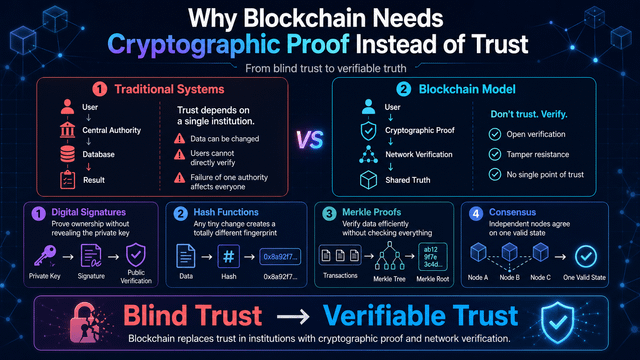
Traditional systems work like this:
User ↓ Central Authority ↓ Database ↓ ResultThe database says:
“Your balance is 1000.”
You believe it because you trust the institution.
But what if:
the data is changed? the system fails? the authority becomes dishonest?The user has no direct way to verify the truth.
Blockchain introduces a different idea:
Don’t trust. Verify.
Instead of relying on a central authority, blockchain uses cryptographic proof.
The model changes:
Traditional: Trust → Verify Blockchain: Verify → Trust 1. Digital Signatures: Proving OwnershipIn blockchain, ownership is not based on a username or account database.
It is based on cryptography.
A transaction contains:
Private Key ↓ Digital Signature ↓ Public VerificationAnyone can verify:
Was this transaction signed by the owner? Was it modified?Without knowing the private key.
2. Hash Functions: Protecting Data IntegrityBlockchain uses hash functions to create unique fingerprints.
Example:
Transaction Data ↓ Hash ↓ 0x8a92f7...Even a tiny change creates a completely different hash.
This makes hidden modification extremely difficult.
3. Merkle Proofs: Verifying Without Checking EverythingA blockchain block may contain thousands of transactions.
Nodes do not always need to download everything.
Merkle trees allow efficient verification:
Transactions ↓ Merkle Tree ↓ Merkle Root ↓ Block HeaderA single root can represent the entire dataset.
4. Consensus: Creating Shared TruthA blockchain has thousands of independent nodes.
They do not trust each other.
So they use consensus:
Node A Node B Node C Node D ↓ Consensus ↓ One Valid StateThe network agrees on the same history through verification.
5. Why This Matters for the Future InternetThe next internet will not only connect humans.
It will connect:
AI Agents autonomous systems digital assets smart contractsThese systems need a way to cooperate without knowing each other.
An AI Agent asking:
“Can I trust this Agent?”
should not depend on:
a company a platform a databaseIt should depend on:
Identity + Cryptographic Proof + Verified HistoryThe fundamental shift is:
From:
"Trust me, I am honest."To:
"Verify it yourself."Blockchain is not powerful because it removes trust completely.
It is powerful because it replaces blind trust with verifiable trust.
The future question is not:
“Who should we trust?”
It is:
“Can we build systems where trust can be verified?”
#Blockchain #Ethereum #Cryptography #Web3 #FutureInternet
submitted by /u/Patient_Cream_4361 [link] [comments]
r/CryptoCurrencyRead More
You might also be interested in reading Retail-Focused Phillip Securities Pivots to Institutional FX Market.