


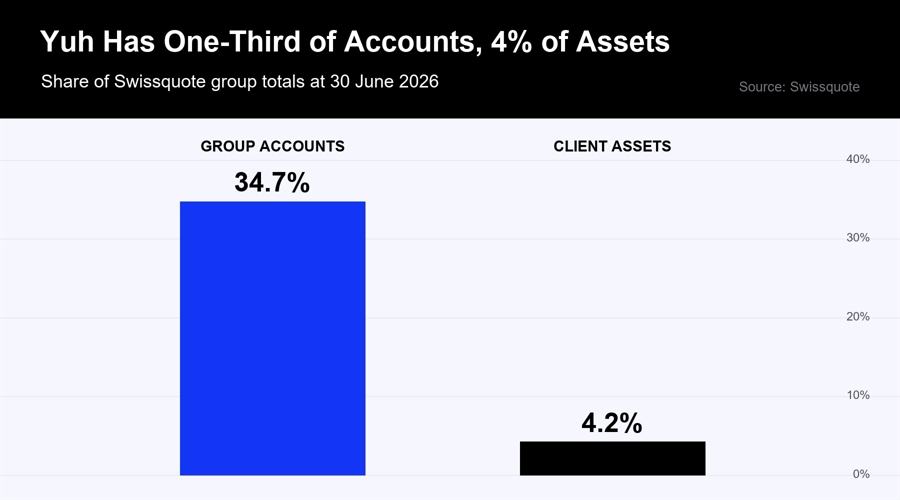
Swissquote reported more than 1.2 million accounts at the end of June, but those accounts do not carry equal economic weight. Yuh, its mobile finance app, held 34.7% of the total and only 4.2% of client assets.
A new FM Intelligence study shifts attention from how many users Swissquote has acquired to how much of that reach becomes funded banking and investing relationships. The gap is measurable. It gives investors a way to track Yuh’s role in Swissquote’s 2028 revenue and profit targets.
FinanceMagnates.com already covered Swissquote’s H1 2026 results, including client assets approaching the next major threshold and a sharp decline in crypto income. The account mix reveals a separate issue that the headline earnings figures do not show.
One Account Base, Two Different Asset Levels
Yuh reported 423,409 accounts and CHF4.01 billion (about $4.90 billion at current rates) of client assets at 30 June. Swissquote excluding Yuh had 797,409 accounts and approximately CHF92.26 billion of client assets.
That works out to about CHF9,480 per Yuh account, compared with CHF115,700 outside Yuh. The difference is 12.2-fold. It is a point-in-time density measure, not a customer conversion rate or evidence of revenue or profit per customer.
[#highlighted-links#]
Account definitions may also differ between the two businesses. Younger accounts have had less time to accumulate assets, while a mobile app can attract users with smaller initial balances.
Swissquote does not publish the cohort data, funded-account ratio or segment-level economics needed to separate those effects.
Why the Yuh Gap Matters for 2028
Swissquote targets CHF950 million of net revenue and CHF500 million of pre-tax profit in 2028. Its revised 2026 guidance is approximately CHF730 million and CHF365 million, respectively.
Accounts alone are insufficient. Newer relationships must contribute deposits, trading activity, custody assets or other revenue at a pace that supports the target.
Full consolidation of Yuh since July 2025 has increased reported reach, but Swissquote has not disclosed Yuh’s standalone H1 2026 profit contribution.
The distinction between account growth and account economics also applies to broker comparisons. Recent FM Intelligence research on Interactive Brokers found that account expansion and balance-sheet growth, rather than higher pricing, drove much of its Q2 performance.
Definitions matter. Within-company trends are more reliable than direct rankings built from unlike customer and asset measures.
The full Swissquote report on DataLab includes the account and asset bridge, the crypto volume and realized-rate decomposition, peer comparisons and the arithmetic behind the 2028 target hurdle.
This article was written by Damian Chmiel at www.financemagnates.com.AnalysisRead More
You might also be interested in reading Ethereum holders back in profit as ETH price gears up for $4K breakout.