


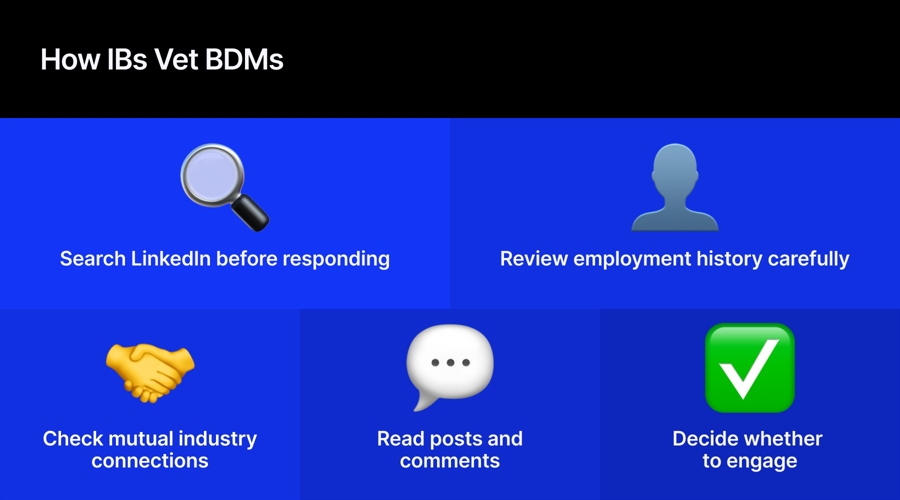
The CFD and forex industry likes to talk about client acquisition in B2C terms: funnels, deposits, cost per lead. But the engine behind most brokers’ growth sits one layer back, in B2B: the network of Introducing Brokers, affiliates, and money managers who feed client flow into a brokerage, and the Business Development Managers (BDMs) who recruit and manage that network.
Retail FX/CFD volume broke through $30 trillion a month, according to Finance Magnates’ reporting, and the global retail funded-account base surpassed 12.4 million by the end of 2025, up nearly 40% in three years. None of that growth happens without a functioning B2B layer underneath it, and that layer only works if the people running it can be found, vetted, and trusted by the partners they are trying to recruit.
That is the part of the CFD business that gets discussed least: how partnerships actually start. Increasingly, they start on LinkedIn.
The IB Doesn’t Cold-Call Anymore
IBs and affiliates still show up at expos, still shake hands, still walk away with a stack of business cards. That part of the industry hasn’t disappeared. What has changed is what happens next. The card used to be the end of the interaction. Now it’s the start of one: the affiliate goes home, opens LinkedIn, and does the due diligence before ever replying to a follow-up email.
Across B2B industries generally, 75% of buyers say they use social media to research a vendor before engaging a salesperson, and LinkedIn is consistently cited as the primary channel for that research. Buyers don’t evaluate the company first; they evaluate the person representing it.
Some 74% of B2B buyers visit at least three team member profiles before engaging with a vendor at all, and half will simply avoid a salesperson whose profile is incomplete or thin.
That behaviour maps almost exactly onto how a serious affiliate now vets a broker’s BDM. Before an IB commits a portfolio of clients, and the revenue that portfolio represents, to a new brokerage, the person on the other end of the message gets searched, scrolled, and cross-referenced. Not the company page. The individual.
The BDM’s Profile Functions as a First Compliance Check
In most B2B verticals, this is simply called social selling. In CFD B2B, it functions closer to due diligence. The industry already has a well-established verification culture on the retail side, where traders are told to check a broker’s licence against the official register of the FCA, ASIC, CySEC, or an equivalent regulator before depositing a cent. Affiliates apply the same instinct one level up the chain. The object of scrutiny isn’t a licence number; it’s a LinkedIn history.
A serious affiliate reviewing a prospective BDM is typically looking for a specific pattern: tenure at previous companies rather than a string of five- and six-month stints, mutual connections who can vouch informally, endorsements or comments from recognisable names in the space, and visible activity suggesting the person is genuinely embedded in the industry rather than freshly created for outreach purposes.
In a market where “which broker actually pays out on time” is one of the most common questions in any IB group chat or forum thread, a BDM’s digital footprint becomes a proxy for that answer. If the individual looks unstable or unverifiable, the affiliate reasonably extends that doubt to the brokerage standing behind them.
This is why LinkedIn’s own performance data on social selling is directly relevant to B2B CFD outcomes, not just a B2C marketing statistic.
Sales professionals with a high Social Selling Index generate roughly 45% more opportunities and are 51% more likely to hit quota, according to LinkedIn’s State of Sales Report 2025, and companies with strong social-selling adoption report 51% higher revenue attainment than those without it. For a BDM whose entire job is sourcing and closing IBs and affiliates, that isn’t a marketing footnote. It is close to a job description.
Hunting, Not Waiting
This changes what “a good BDM” actually means inside a CFD brokerage. The old model rewarded relationship inheritance: a BDM with an existing book of contacts who could be poached, onboarded, and expected to bring commission with them from day one.
That model is a major contributor to the industry’s well-known revolving-door hiring pattern, where BDMs move from broker to broker every few months and brokers spend heavily to acquire a “portfolio” that often turns out thinner in practice than it looked on paper.
The alternative is a BDM who actively hunts new partners rather than only managing an inherited book, and does it through the same channel affiliates already use to vet them: social media. That means publishing, commenting, showing up in relevant industry conversations, and building a visible, checkable track record long before a first message is ever sent.
An estimated 80% of B2B leads across industries now originate on LinkedIn, and there is no structural reason CFD B2B should be an exception.
Job postings for BDM and IB-acquisition roles across the industry already list “an active network of contacts” as a baseline requirement. What is less openly discussed is that the network itself is now built and verified largely on one public platform, in full view of everyone deciding whether to work with you.
For brokers, this has a direct operational implication. Recruiting a BDM for their inherited book is a short-term fix, and it is exactly the approach that produces high turnover and the roughly USD 20k average cost per hire many brokers absorb before seeing a real return.
Recruiting or training a BDM who knows how to hunt, and who treats their own profile as an asset worth maintaining, is a longer build but a more durable one. It is also cheaper to retain, since a BDM who is generating genuinely new relationships has less incentive to jump every few months, chasing a marginally bigger fix elsewhere.
The Badge, Not the Business Card
For a BDM in this industry, a LinkedIn profile is not a digital business card that gets handed out and forgotten. It functions closer to a badge: something an affiliate checks before deciding whether to trust that person with client flow, commission structures, and, indirectly, their own reputation with their downstream clients.
An incomplete profile, a suspiciously short job history, or an absence of any real industry activity reads the same way as an unlicensed broker reads to a retail trader. It is a reason to walk away before the conversation even starts.
Brokers who treat this as a personal branding afterthought for their BDMs are underestimating a real acquisition channel. Brokers who treat it as core to how they hire, train, and evaluate their B2B sales force are the ones more likely to build partner networks that do not need replacing every few months.
This article was written by Badea Alexandru Gabriel at www.financemagnates.com.Retail FXRead More
You might also be interested in reading Love or hate her, the much-disputed spirit of Margaret Thatcher continues to march through UK politics.