


Interactive Brokers Group’s second-quarter net revenue rose 28% to $1.90 billion, and most coverage focused on the headline growth. A FM Intelligence deep dive looks at how that growth was built, and finds a balance-sheet story rather than a rate story.
The full breakdown sits on the FM Intelligence DataLab portal, which traces where the activity actually came from over the past ten quarters.
Margin Loans Up 67% While Accounts Rose 34%
Customer margin loans reached $108.5 billion at the end of June, up 67% from a year earlier. That outpaced the 34% rise in customer accounts, to 5.19 million, and the 40% rise in customer equity, to $930.3 billion.
Borrowing per account rose about 24%, to roughly $20,900, and margin loans equalled 11.7% of customer equity, the highest reading in the period the analysis covers.
Net interest income rose 23% to $1.06 billion, yet net interest margin fell to 1.93% from 2.07%, a sixth straight year-over-year decline, as the yield on margin loans dropped to 4.10%. The growth came from a larger balance sheet, not higher rates. Interactive Brokers’ headline results were covered separately by FinanceMagnates.com.
What the Deep Dive Projects for the Second Half
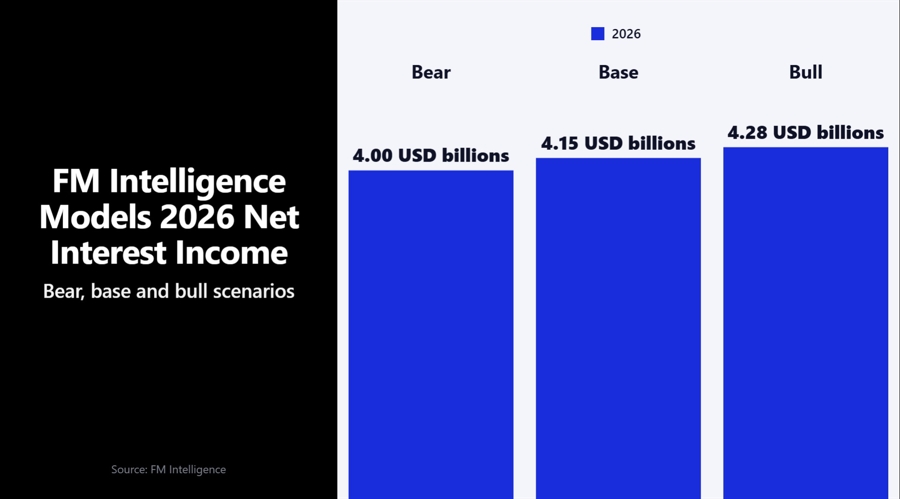
Using the rate sensitivity Interactive Brokers discloses, about $82 million of annual net interest income for each 0.25 point move in US dollar rates, FM Intelligence models 2026 net interest income in a range of $3.95 billion to $4.30 billion, with a base case near $4.15 billion.
The scenarios turn on the rate path, which has shifted from the cuts assumed for much of 2025 toward a hold or a modest rise, and on how fast customer balances grow. The figures are FM Intelligence estimates, set out as base, bull and bear cases.
The Digital-Assets Read-Through
Broadening retail activity also points beyond equities. Paul Howard, senior director at digital-asset liquidity provider Wincent, said Interactive Brokers’ results confirm retail trading remains active across equities, commodities and derivatives, and that AI-driven tools are lowering the barrier to more complex products.
He expects digital assets to take a larger role in the second half as investors rotate into markets that have lagged the year’s rally.
“I expect crypto trading volumes to once again exceed $100 billion during H2,” Howard said.
That call runs ahead of recent data: retail order flow rebounded in June while crypto trailed the move, as FinanceMagnates.com reported.
The full analysis, charts and scenario tables are on the FM Intelligence DataLab portal.
This article was written by Damian Chmiel at www.financemagnates.com.AnalysisRead More
You might also be interested in reading Singaporean financial watchdog to consult public on stablecoin regulation.