


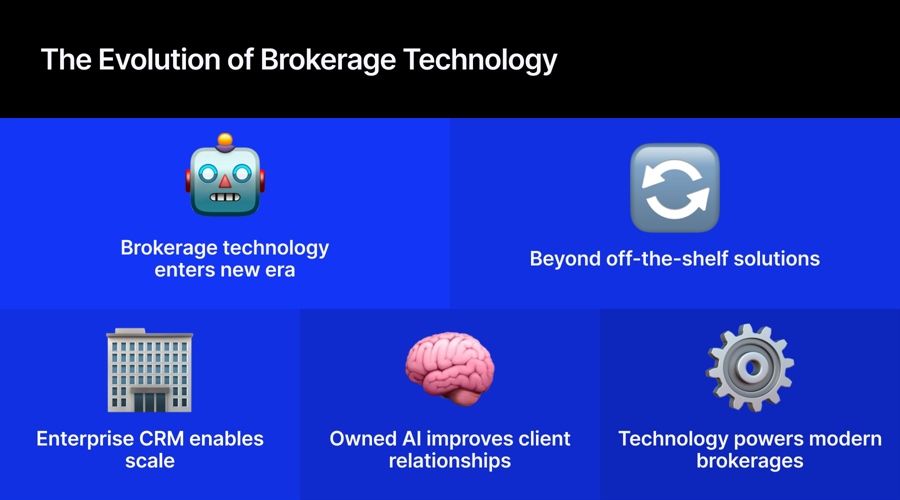
Over the course of my career in the retail financial services sector, I have watched the barrier to entry for launching a brokerage drop remarkably. As we pass the middle of 2026, we have entered a golden age of specialized, out-of-the-box brokerage technology.
The capability of modern Forex CRM systems is deeply impressive, and often remarkably well suited to the needs of the modern trading industry.
These niche platforms solve many of the immediate operational headaches brokers face. They plug seamlessly into MetaTrader or cTrader environments and untangle complex, multi-tier IB rebate structures. More recently, they have introduced something even more compelling: built-in artificial intelligence tailored to the lifecycle of the retail trader.
Today, a broker can purchase a software license and instantly deploy AI pre-trained on industry behaviors: automated lead scoring built on signals unique to our space, such as demo account engagement or KYC document upload speeds, and predictive churn algorithms that spot shifts in trading activity and trigger personalized retention campaigns before a trader even reaches the withdrawal button.
For many early-stage and mid-tier brokerages, this plug-and-play intelligence is a highly effective lifeline, allowing them to punch well above their weight without an army of developers.
Why Scale Changes the Technology Question
As I recently stepped into the role of Managing Director at Scope Markets, however, I found myself evaluating our technology stack from a different vantage point. Scope Markets is in a phase of rapid, sustained global growth, operating from the solid institutional foundation we have established as a group under the Rostro umbrella with Scope Prime.
The question I put to our executive team was not whether off-the-shelf technology works. We already have the data to confirm that it does, but the broader question was whether it could support the standard of service and depth of client relationships we want to define us.
For us, the answer came down to the client journey. Our clients engage with us across many touchpoints, such as onboarding, funding, education, trading, and support, all of which increasingly span multiple regions and product lines.
We want every one of those interactions informed by a single, complete view of the client, so that our service feels personal, consistent, and proactive wherever a client meets us. Delivering that level of connection means owning the intelligence behind it, and that conviction drove our strategic, admittedly contrarian, decision to implement Salesforce as our core operational architecture.
Building an Enterprise Technology Foundation
Within the retail trading space, adopting a global, agnostic enterprise CRM like Salesforce is widely understood to be the harder path. It does not speak “Forex” natively, and it requires significant capital investment, heavily customized development, and API middleware to read live margin levels and align with complex financial regulatory workflows.
For a firm operating at our scale, that heavy lifting is not a drawback; it is rather an investment in the experience of our clients. An enterprise ecosystem gives us full data sovereignty and the freedom to focus on the customization that serves our clients best. We can train our own AI models on our own unique datasets, so the insights that shape each client’s experience reflect how our clients actually trade and what they actually need.
Turning Data into Better Client Experiences
In practice, that translates into tangible benefits: complete visibility of every relationship for our teams, more relevant communication, faster support, and outreach that anticipates a client’s needs rather than reacting to them. In an industry where data has become one of a firm’s most valuable assets, keeping that intelligence in-house allows us to protect it, refine it, and reinvest it directly into the client experience.
An open, enterprise-grade architecture also acts as a limitless operating system that can be iterated and built upon. Its agnostic API framework lets us integrate new fintech modules, support new asset classes, and launch new divisions quickly, scaling precisely alongside our ambition. As we grow, the client experience becomes richer and more connected, and never more fragmented – fully aligned with our long-term goals.
Owning the Future of Brokerage Technology
I want to be clear: specialized, turnkey CRMs will always have a vital and respected place in this industry. They are the engines of industry accessibility and have their advantages. But as a brokerage scales, technology can no longer be viewed merely as an operational tool – instead, it is the very DNA of the relationship you hold with your clients.
At Scope Markets, we are making complex, necessary investments today to ensure our infrastructure is as robust, dynamic, and forward-looking as the clients we serve. The retail trading industry is maturing rapidly, and we believe the firms best placed to lead it long term will be those that own the technology behind every client relationship. That is the future we see and the future we’re building.
This article was written by John Murphy at www.financemagnates.com.Retail FXRead More
You might also be interested in reading Is Avalanche About To Blow? Don’t Miss This Potential Breakout – Analyst.