


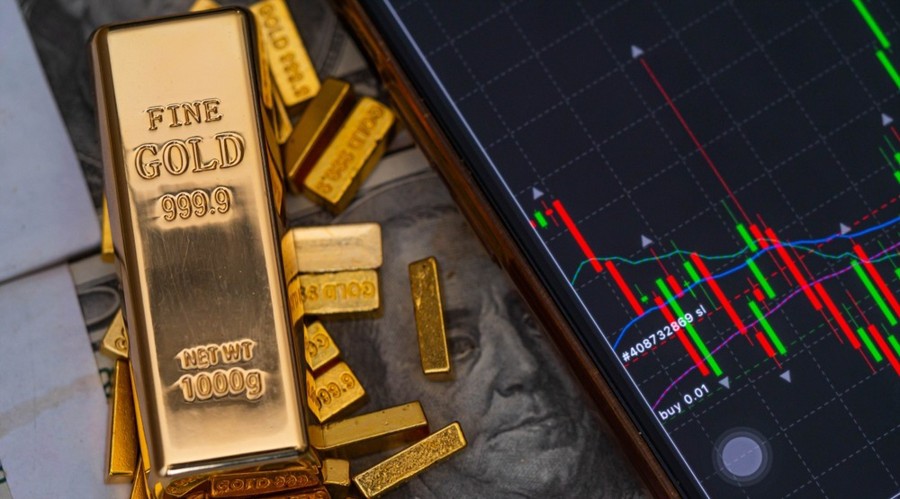
Gold fell 1% to $4,289.87 per ounce on Monday, June 8, 2026, sliding to a two-month low and trading below its 200-day moving average for the first time since October 2023, after Friday’s hotter-than-expected US jobs report revived bets on a Federal Reserve rate hike.
Why Gold Is Going Down Today?
Friday’s session alone stripped more than 3% off the price, the steepest single-day drop in recent weeks. The metal now sits roughly 23% below the $5,595 record set on January 29. So why is gold going down, and how far can this correction run?
Friday’s drop erased gold’s entire 2026 advance, leaving it down 0.3% year to date after a sharp first-quarter run. Spot silver fell 0.7% to $66.87, leaving both metals near flat for the year.
Through the spring I stayed structurally bullish, calling the $4,650 to $4,360 area a buying opportunity in my earlier work. Friday’s break changed that. The level I treated as support is now resistance, and the burden of proof has shifted to the bulls. This week’s catalysts are US CPI, a run of Fed speakers, and the next move in oil.
Follow me on X for real-time market analysis: @ChmielDk
The Macro Drivers Behind the Drop
Gold’s slide is a rates story first. Friday’s US labor data came in well above forecasts, pushing traders to price a more than 50% chance of at least one Federal Reserve rate hike in 2026, a sharp reversal from the rate-cut expectations held earlier this year.
The US 10-year Treasury yield climbed above 4.50%, its highest in two weeks, while German 10-year yields pushed above 3.00%. Higher yields raise the opportunity cost of holding gold, which pays no income.
The second driver is inflation risk from energy. Renewed Israel-Iran strikes and attacks in Lebanon lifted oil prices, reviving fears of sticky inflation and a higher-for-longer policy stance. The pressure is not confined to Washington. The Bank of Japan is increasingly expected to raise rates, and the European Central Bank is seen tightening at its next meeting.
“Higher interest rates across major economies could create more challenging conditions for gold,” said Somesh Kapuria, CEO of Hola Prime. Kapuria tied the move to stronger US labor data and renewed Middle East tensions feeding both yields and inflation expectations.
The bear case for gold right now rests on a tight cluster of macro signals:
US jobs data beating forecasts, lifting Fed hike odds above 50% for 2026 10-year Treasury yields above 4.50%, the highest in two weeks An oil rebound on Middle East escalation, reviving inflation fears The BoJ and ECB both leaning toward tighter policy A firmer dollar raising the cost of bullion for non-dollar buyersGold Technical Analysis: The 200-Day EMA Break
My chart shows gold testing the lower edge of the consolidation it has traced since March, a range capped near $4,800 and floored by the 200-day exponential moving average.
Friday’s close pushed price below the 200-day simple moving average near $4,412 and the 200-day exponential moving average near $4,380, the bull and bear line I flagged in late March.
The rally into January was so steep that price had not closed below this average in well over two years. Momentum still has room to fall, with the 14-day relative strength index near 46, short of oversold.
In 15-plus years as a trader and analyst, including a decade covering metals for FinanceMagnates.com (my analyst page), I have learned a 200-day moving average break is a warning, not a verdict.
The 2022 and 2023 breaks went opposite ways. After gold lost the average in mid-2022, it slid from around $1,900 to roughly $1,620 by the autumn. The October 2023 break, by contrast, reversed within weeks and gave way to a fresh record-setting run.
The line in the sand now is the $4,280 to $4,400 zone, the October 2025 highs. A decisive close below it confirms the break and, by my read, opens the path toward the $3,440 floor I have mapped before in my March crash analysis.
That target marks the June and July 2025 peaks and the 100% Fibonacci extension of the January-to-March decline projected off the April bounce, a drop of around 20% from current levels. A reclaim of $4,400 would keep the break a false signal, as in 2023.
Gold Price Prediction 2026
The institutional consensus is still bullish, which is exactly why the current break matters. Goldman Sachs holds a $5,400 year-end target, which I see as out of reach unless price reclaims $4,400 within weeks. UBS targets $5,600 but has flagged a late-stage cycle, a caveat my chart now echoes.
UBP rebuilt bullion positions toward a $6,000 call, a level that looks remote while gold trades below its 200-day average. JPMorgan’s $6,300 sits at the top of the range and, in my view, prices in a return to aggressive Fed easing that the data is not delivering.
The Reuters poll median of $4,746.50 is the most realistic bull case, though it still assumes the consolidation holds. On the bear side, the World Gold Council’s “Reflation Return” scenario of $3,360 to $3,990 lines up almost exactly with my own $3,440 target, and the triggers it named, a hawkish Fed, higher yields, and a stronger dollar, are now live. My base case is a test of $3,440 if $4,280 gives way. A weekly close back above $4,400 is the one signal that would force me to drop the bearish call.
FAQ, Gold Price Analysis
Why is gold going down in June 2026?
Gold fell to $4,289.87 on June 8, 2026, after Friday’s strong US jobs report pushed Fed rate-hike odds above 50% for the year. The US 10-year yield rose above 4.50%, raising the opportunity cost of holding non-yielding bullion. Renewed Middle East tensions lifted oil and inflation fears, reinforcing a higher-for-longer policy outlook that weighs on gold.
What is gold’s 200-day moving average and why does the break matter?
Gold’s 200-day simple moving average sits near $4,412 and the exponential version near $4,380. On Friday, price closed below both for the first time since October 2023, a signal traders read as a shift in the long-term trend. History is mixed: the mid-2022 break preceded a slide to $1,620, while the 2023 break reversed within weeks.
How low can gold go in 2026?
My chart targets $3,440 if gold closes below the $4,280 support zone, a drop of around 20% that aligns with the June and July 2025 peaks and the 100% Fibonacci extension. The World Gold Council’s bear scenario points to $3,360 to $3,990. A reclaim of $4,400 would cancel the bearish setup and keep the consolidation intact.
What is the gold price prediction for 2026?
Forecasts span a wide range. The Reuters poll median is $4,746.50, while Goldman Sachs targets $5,400, UBS $5,600, UBP $6,000, and JPMorgan $6,300 by year-end. On the bear side, my $3,440 target and the World Gold Council’s $3,360 to $3,990 scenario frame the downside. The direction hinges on whether the 200-day average is reclaimed.
Is gold a buy after the 200-day moving average break?
Not yet, by my read. A 200-day break is a warning, and confirmation comes only on a daily close below $4,280, which would open $3,440. A reclaim of $4,400 would flip the signal, as in 2023. I would wait for one of those two lines to resolve before taking a directional stance. This is analysis, not investment advice.
This article was written by Damian Chmiel at www.financemagnates.com.TrendingRead More
You might also be interested in reading China’s industrial output and retail sales miss expectations in August; jobless rate ticks up.