


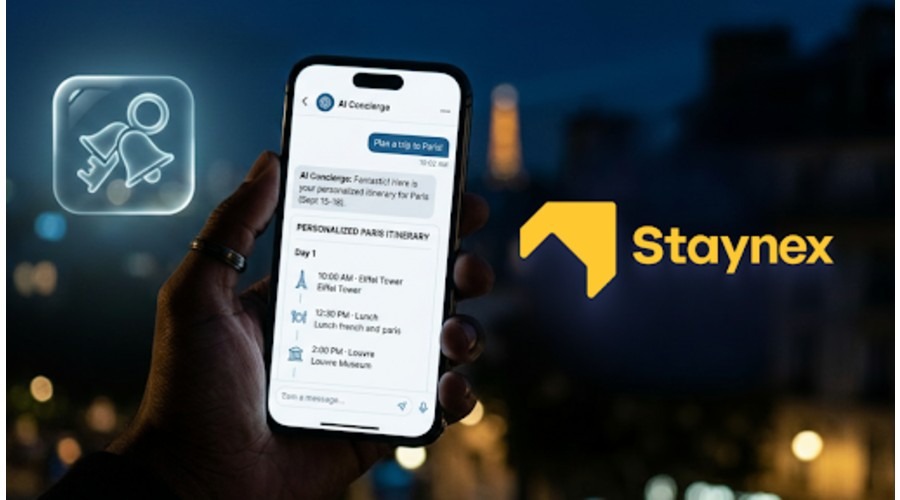
Online booking made travel more accessible, but it also left travelers to make sense of too many options on their own. AI-integrated booking brings the concierge idea back through a more connected planning flow.
The travel industry has witnessed explosive growth in recent years. Social media prompted and inspired users to explore the next destination. Meanwhile, access to travel services has become easier, thanks to increasing digitalization.
Travelers can now book a trip with a few clicks on their own, wherever they are. The effect of this structural change was tremendous; travel and tourism generated $11.6 trillion in revenue in 2025, accounting for nearly 10% of global GDP.
Booking got easier, but planning didn’t
But does seamless booking always mean easy planning? Travel planning was a relatively straightforward process during the time of travel agents and concierge services. Agents acted as gatekeepers who filtered down options for customers and assisted them in planning the trip.
For those only wanting to pack their suit and go, concierge services took things one step further and planned all details of the trip on behalf of travelers, from booking flights and hotels to organizing tours and securing reservations.
Things have changed with the Internet. Online travel agencies (OTAs) and aggregators took over the scene, enabling travelers to book trips on their own. They provided access to a much wider range of options and allowed users to compare prices from different providers.
While making a booking became labor-saving technically, this new model shifted the planning responsibility to users. Travel assistance has been mostly gone; travelers now have to review a myriad of options, match flights with check-in and check-out times, and piece together the rest of the trip before booking.
Artificial intelligence (AI) can reintroduce the disappearing assistance and bring the convenience of concierge services back to travel.
AI as a travel planner
Booking through OTAs is a dizzying experience. The process starts with entering a destination and dates, but quickly turns into a long sorting exercise. Travelers check whether the same room is cheaper elsewhere, read cancellation rules, inspect location maps, match flights with check-in and check-out hours, and keep track of which option had the better trade-off while getting lost among a dozen open tabs. The booking itself may take only a few clicks, but the planning behind it still requires a good deal of time and attention.
AI can take over much of this planning task by working from context. A traveler can describe the kind of trip they want, including budget, dates, preferred pace, location expectations and hotel standards, and the system can build around that request. It can suggest an itinerary, compare live prices across large hotel inventories, narrow down suitable stays, adjust the plan when the traveler adds new details, and provide booking links once the options are clear.
The tech is here, but consumers are still reluctant to delegate planning to AI. More than 60% of travelers prefer human curation over AI suggestions, according to a recent survey. The most cited reason is inaccurate information on prices, availability, links to bookings, and details about attraction sites.
The roots of this trust problem lie not in the tech, but in its integration. A surface-level AI tool can only respond based on what the user types and the data it can access at that moment. The process is time-consuming and often requires a cross-check by the traveler. At this point, AI just adds an extra layer to consider rather than streamlining planning.
For AI to be relevant in travel planning, it needs real-time access to changing information. If it is not connected to live inventory, its suggestions can quickly become outdated or incomplete.
But live inventory alone does not solve the planning burden. Travelers do not only need current information; they need that information to be organized into a trip that makes sense. And a simple AI chatbot may fall short of meeting these needs.
A chatbot can answer a travel question, but it still leaves the traveler to carry the answer into the rest of the process. An integrated concierge has to stay with the user through the planning flow.
Staynex’s AI Travel Wingman is built to provide this service. The feature works inside the platform’s booking environment, drawing from live inventory across more than 2.65 million hotels instead of producing general suggestions detached from availability. A traveler can describe the kind of trip they want, and the AI agents can turn that context into hotel options, itinerary suggestions and booking links without forcing the user to restart the process elsewhere.
The platform also has a membership infrastructure, which makes the concierge model more practical. It allows AI to work with a broader travel context, including past bookings, saved preferences, payment choices and reward activity.
The reward activity comes from Staynex’s Travel-to-Earn model. Conventional loyalty programs are around points that may expire before the next trip. Meanwhile, this model lets travelers earn rewards through bookings without putting an expiration date on that value.
On Staynex, once the plan is ready, travelers can complete the booking through more than 300 crypto and fiat payment rails. This gives users payment flexibility without making the trip-planning experience depend on a single method.
Planning inside the booking flow
AI-integrated booking points to a larger change in what a travel platform can be. It is not simply a chatbot added to a search engine or an assistant placed beside the booking flow. When built into the core of a platform, AI changes the architecture of the journey itself. Search, comparison, planning, and booking no longer have to sit in separate steps that the traveler manually connects.
With the self-booking model, travelers were given access to more options, but they also inherited the work of understanding those options. AI can take some of that work back from travelers and bring assistance back into the process without returning to the limits of traditional agencies or concierge services.
For this model to work, AI cannot sit outside the journey as a side tool. It has to be connected to the booking process itself. Otherwise, the traveler still has to check whether the suggestion is current, compare it with other options, and carry the plan into a separate booking flow. The value of AI-integrated booking lies in making planning and action feel less disconnected.
This article was written by FM Contributors at www.financemagnates.com.Thought LeadershipRead More
You might also be interested in reading Chinese AI Firms Are Tracking US Military Ships in the Iran War Using Only Public Data.