


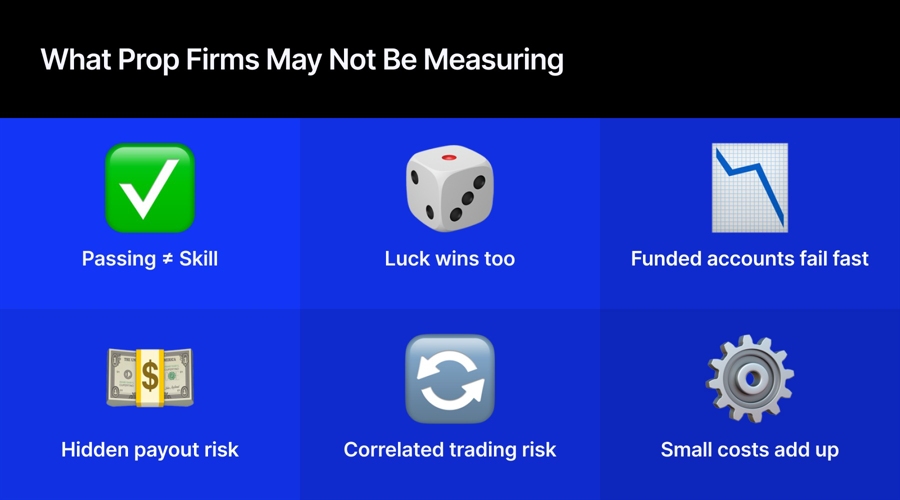
In proprietary trading, the conversation about risk has become increasingly sophisticated. Firms have invested in evaluation frameworks, drawdown controls, and consistency requirements designed to filter for genuine trading ability. What has received considerably less attention is the economic integrity of what comes after evaluation: the funded account stage, and specifically, whether the performance being rewarded reflects real skill or statistical noise.
This distinction matters more than it appears. And the industry’s current measurement infrastructure is not well equipped to make it reliable.
Evaluation Passes for the Wrong Reasons
The dominant model in retail proprietary trading treats evaluation completion as a sufficient proxy for trading ability. A trader who achieves a defined profit target within stated risk parameters receives a funded account. The underlying assumption is that doing so demonstrates reproducible edge.
That assumption deserves scrutiny.
In any sufficiently large population of traders operating under the same rules, a meaningful proportion will achieve the profit target through variance rather than skill. This is not a controversial claim. It is a statistical property of any performance-gated system operating at scale. The question is not whether it occurs, but how frequently, and what the cumulative financial effect is on firms that cannot distinguish between the two.
Related: The Systemic Cost of Copy Trading in Prop Trading Firms. What’s the Solution?
At a small scale, the error rate is manageable. A few variance-driven accounts reaching funded status impose limited cost. At the scale that characterises the largest retail prop firms, operating tens of thousands of funded accounts simultaneously, the aggregate effect becomes material.
Funded accounts backed by variance rather than edge do not perform differently during evaluation. They perform differently afterwards. They fail at higher rates, they fail faster, and they cluster their failures in ways that correlate with market conditions rather than individual risk decisions. For the firm, this creates a payout structure that is partly rewarding skill and partly absorbing the natural volatility of accounts that should not have been funded in the first place.
The economic cost is real but largely invisible. It does not appear in any single account’s metrics. It accumulates across the book.
The Consolidation Problem
A related but distinct issue concerns how payout exposure is aggregated across the funded account population.
Most proprietary trading firms assess risk at the account level. Individual drawdown limits, profit targets, and consistency requirements are defined, monitored, and enforced per account. This is appropriate for evaluation purposes. It is structurally inadequate for understanding the firm’s aggregate liability at any given point in time.
Consider a firm with ten thousand funded accounts. At any moment, a subset of those accounts is approaching payout eligibility simultaneously. If their underlying strategies are correlated, whether through copy trading, common signals, or shared market behaviour during volatile regimes, the consolidated payout exposure at the firm level may be substantially higher than any account-level view would suggest.
Read more: “Every Design Choice in Prop Trading Creates a Corresponding Risk,” Arizet Labs’ CEO
This is not a theoretical concern. It is a structural feature of any large-scale funded trading operation in which individual accounts are evaluated in isolation while their collective behaviour is shaped by the same market conditions. The absence of a consolidated real-time view of payout liability is not a gap that individual account monitoring can fill. It requires a different layer of analysis entirely.
Firms that lack this consolidated view are not necessarily taking on more risk than they intend. They simply do not know. And not knowing, at scale, has a cost.
Eventually it balances out with the gamblers. The more difficult thing is the folks who have made a system just to manipulate the rails of prop. So they aren’t using their “trading skill” they are using the drawdown figures and payout frequency to make sure they come out on top.…
— Josh Dentrinos – Founder of Trader Fights (@PropJoshD) August 22, 2025
Execution Economics at the Firm Level
The third dimension of this problem is execution cost visibility, which is perhaps the least discussed of the three.
Retail proprietary trading firms typically assess execution quality at the account level. Spread, slippage, and commission data are available per account and per trade. What is rarely measured is how execution cost compounds across the funded account population as a whole.
In a firm operating tens of thousands of accounts, small systematic inefficiencies in execution, spread capture, or order routing, repeated across every trade across every account, produce aggregate costs that are significant but fragmented. No individual account flags the problem. No single trade is obviously expensive. But the aggregate effect, measured at the firm level rather than the account level, tells a different story.
This is not a criticism of any particular firm’s operations. It reflects the fact that the tools most firms use to monitor execution were designed for single-account or single-desk environments. They were not designed to surface cost patterns that only become visible when aggregated across a large, distributed funded account population.
The result is a blind spot that is structural rather than operational. The data to identify it exists. The analytical framework to interpret it typically does not.
What Institutional Practice Looks Like
None of these issues is novel to participants with institutional trading backgrounds. Portfolio-level risk aggregation, performance attribution analysis, and execution cost measurement across distributed strategies are standard practices in hedge fund and asset management environments. The infrastructure for addressing them exists and has existed for some time.
What is notable about the retail proprietary trading sector is how rarely this institutional perspective has been applied to the economics of the funded account model. The industry has developed sophisticated front-end products: evaluation frameworks, trader interfaces, payout structures, and community infrastructure. The back-end analytics layer, the one that tells a firm what is actually happening across its funded account population in aggregate, has not kept pace.
Read more: US Prop Firms Are Now Moving Inside the CFTC Perimeter. An Opportunity or a Survival Strategy?
This is beginning to change. A small number of firms are starting to apply portfolio-level risk thinking to their funded account books, measuring performance attribution at the population rather than the account level, and building consolidated liability views that reflect the firm’s actual exposure rather than the sum of individual account snapshots.
The firms doing this are finding that the gap between what their account-level reporting shows and what their population-level analytics reveal is larger than expected. In some cases, materially so.
The Question That Follows
The proprietary trading industry has expanded at a pace that has outrun the maturity of its risk infrastructure. Evaluation frameworks have become more sophisticated. Payout structures have become more competitive. The analytical tools used to understand the economics of the funded account book have not evolved at the same rate.
The question is not whether this gap creates risk. It demonstrably does. The question is whether firms have the infrastructure to see it clearly enough to manage it, and whether the industry will address this structural imbalance before market conditions make the cost of not doing so unavoidable.
In proprietary trading, the most consequential risks are rarely the most visible. Payout economics is increasingly one of them.
This article was written by Shervin Arian at www.financemagnates.com.Retail FXRead More
You might also be interested in reading A Look at the Online Safety Bill and How It Might Affect Privacy in the UK.