


A new analysis by Bitget Wallet of 1.29 million Polymarket wallets in Q1 2026 shows how prediction market users actually behave: they arrive via crypto and stay for sports.
Singapore Summit: Meet the largest APAC brokers you know (and those you still don’t!).
The finding has practical implications for brokers and fintech platforms building in this space. The data shows a clear user progression, with distinct products driving acquisition and retention at different stages.
The Entry Point: Crypto
Crypto markets are where most new users start. Among the smallest traders on the platform — those with the lowest activity levels — crypto accounts for nearly 40% of all trading volume. These are markets that retail users already know, available around the clock, with median trade sizes for Bitcoin and Ethereum sitting at $2–$3.
The capital commitment is low enough that the platform itself is essentially a test environment. The broader user base is heavily retail in composition. In Q1, 82.3% of all wallets traded under $10,000 — the growth is coming from volume of participants, not concentration at the top.
This retail-driven entry point contrasts with the growing institutional interest in the sector, suggesting that user acquisition and capital deployment are still driven by different segments.
The Retention Driver: Sports
Crypto pulls users in, but sports keep them. As traders move up in activity levels, their share of crypto trading declines and sports picks up — from 22.7% among lower-volume users to 29.2% among mid-tier ones. In aggregate, sports were the single largest category by trading volume in Q1, generating $10.1 billion.
The NBA and English Premier League are cited specifically — leagues with dense, predictable event schedules that give users a recurring reason to return. The mechanic is not complicated: frequent games create frequent markets, which sustain frequent engagement.
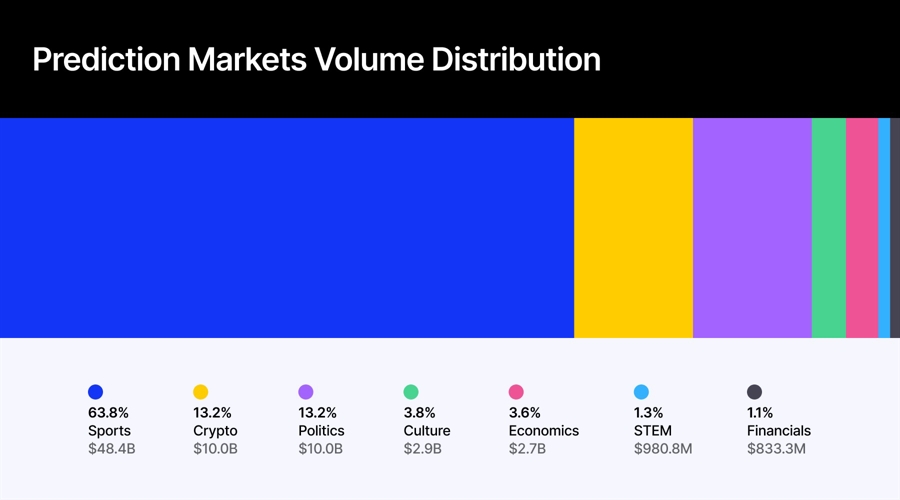
Across the broader market, sports dominate prediction market volume, accounting for roughly 64% of the $75.9 billion tracked by Paradigm’s data set, compared with about 13% each for crypto and politics.
Politics and Macro as the Third Layer
Political and geopolitical markets are growing into a distinct category. Political markets generated $5 billion in Q1 volume, with geopolitics accounting for close to half of that.
These markets operate differently from sports. They’re news-driven and event-dependent rather than calendar-driven, but they add a layer of engagement for users who treat prediction markets as a way to price real-world uncertainty. Total monthly volume on the platform now exceeds $25 billion.
The pattern may reflect product design as much as user preference — particularly the availability of high-frequency sports markets versus more episodic political or macro events.
For brokers, the strategic question the data raises is whether this user journey is platform-specific to Polymarket or whether it generalizes. The onboarding-through-crypto, retention-through-sports pattern suggests product design as much as market demand — and that’s worth examining before assuming the playbook transfers.
This article was written by Tanya Chepkova at www.financemagnates.com.CryptoCurrencyRead More
You might also be interested in reading Latam Insights: IMF to Confine Salvadoran BTC Purchases, Brazil BRICS Payment Bet.