


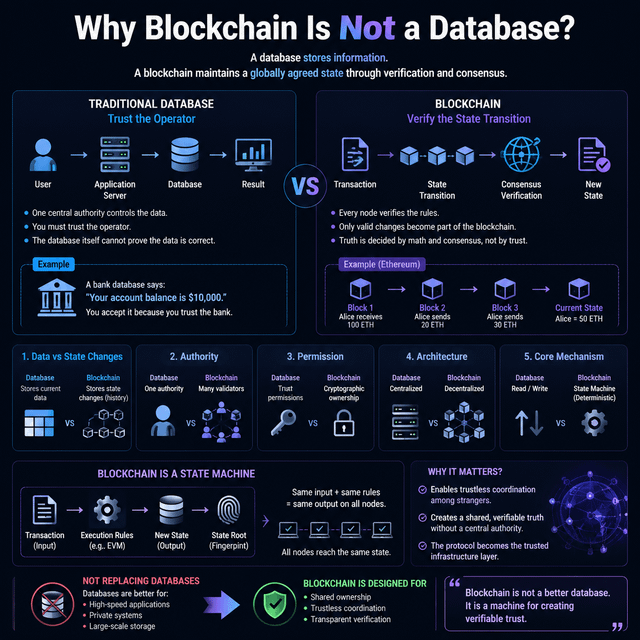
Many people think blockchain is just a new type of database.
But this is a misunderstanding.
A database stores information.
A blockchain maintains a globally agreed state through verification and consensus.
The difference is not where data is stored.
The difference is:
Who decides what is true?
Traditional Database: Trust the OperatorMost databases work like this:
User ↓ Application Server ↓ Database ↓ ResultA company controls:
the database the permissions the update rules the final resultFor example:
A bank database says:
You accept it because you trust the bank.
The database itself does not prove the information is correct.
You trust the organization operating it.
Blockchain: Verify the State TransitionBlockchain works differently.
It does not simply store data.
It verifies how data changes.
The model is:
Transaction ↓ State Transition ↓ New State ↓ Consensus VerificationEvery node checks:
Is the transaction valid? Does the sender have permission? Does the state change follow the rules?Only valid changes become part of the blockchain.
1. Database Stores Data, Blockchain Stores State ChangesA traditional database focuses on:
Example:
Alice Balance = $100Blockchain focuses on:
Example:
Block 1: Alice receives 100 ETH ↓ Block 2: Alice sends 20 ETH ↓ Block 3: Alice sends 30 ETH ↓ Current State: Alice = 50 ETHThe history of transitions creates the current state.
2. Database Has One Authority, Blockchain Has Many ValidatorsDatabase:
Company Server ↓ DatabaseOne organization controls truth.
Blockchain:
Node A Node B Node C Node D ↓ Consensus ↓ Shared StateThousands of independent nodes agree on the same result.
3. Database Trusts Permissions, Blockchain Uses CryptographyDatabase:
“Admin can modify this record.”
Blockchain:
“Only the owner of this private key can authorize this action.”
Example:
Private Key ↓ Digital Signature ↓ Transaction VerificationOwnership is proven mathematically.
4. Blockchain Is a State MachineThe core idea:
Blockchain is not a storage system.
It is a deterministic state machine.
Every node executes:
Same Input ↓ Same Rules ↓ Same OutputExample:
Ethereum:
Transaction ↓ EVM Execution ↓ New Global State ↓ State RootAll nodes must reach the same state.
5. Why Does This Matter?Because blockchain enables coordination without a central authority.
Traditional Internet:
User ↓ Platform ↓ ServiceBlockchain:
User ↓ Protocol ↓ Shared State ↓ ServiceThe protocol becomes the trusted layer.
The Key DifferenceA database asks:
A blockchain asks:
The future of blockchain is not replacing every database.
Databases are better for:
high-speed applications private systems large-scale storageBlockchain is designed for:
shared ownership trustless coordination transparent verificationThe biggest innovation of blockchain is not storing information.
It is creating a system where strangers can agree on the same state without trusting each other.
Blockchain is not a better database.
It is a machine for creating verifiable trust.
#Blockchain #Ethereum #Web3 #Cryptography #FutureInternet
submitted by /u/Patient_Cream_4361 [link] [comments]
r/CryptoCurrencyRead More
You might also be interested in reading Worsening US Dollar, Inflation Metrics Bode Well for Bitcoin’s Continued Rally.