


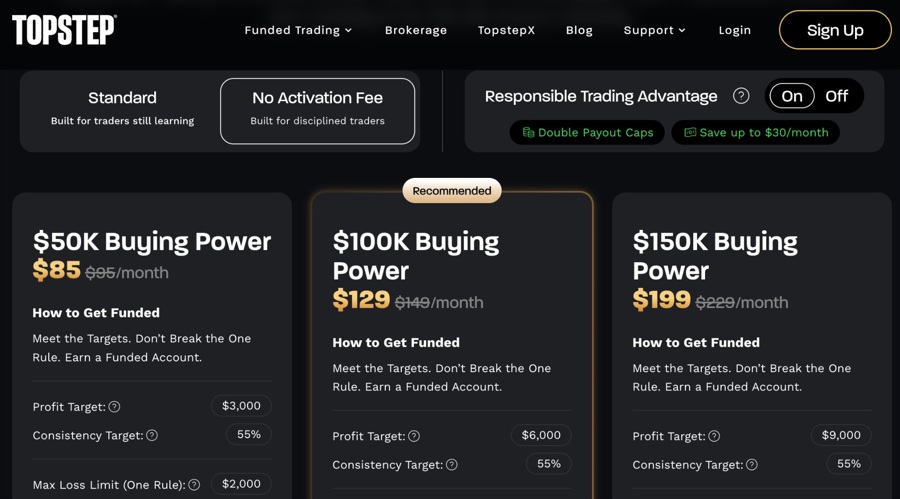
Monthly subscriptions built the futures prop industry, but this year, several of its largest firms stopped selling them. Apex Trader Funding moved new purchases to one-time fees on 1 March, with older accounts grandfathered, and Tradeify followed in the spring. Bulenox stopped using monthly subscriptions for new purchases from 17 August, and My Funded Futures moved new challenge purchases to a one-time fee on 25 August. The data that futures traders see on screen is still billed on a monthly cycle.
London’s trading industry is coming home!
The Subscription Model Gives Way to One-Time Fees
The monthly fee had a reason behind it: it was to pay the CME data license fees. “This is why, in the early days of futures prop firms, evaluation fees were structured as monthly subscriptions,” said Gil Ben Hur, founder of The5ers, tracing the model back to Topstep, the first prop firm in futures.
Around 2023, firms from the CFD space entered the market and brought one-off fees with them. Competition has since produced discounts and bundles of several challenges at once.
Shorter evaluations also weakened the case for recurring billing. “Traders either pass or fail accounts much faster than before,” claims Ruben Abitbol of RUBIK, “which reduces the attractiveness of a recurring subscription model.” The industry, he said, has “shifted significantly toward one-time evaluation fees.”
Tradeify’s own data pointed the same way. Co-founder Vinan Mistry told Finance Magnates in July that most evaluations were resolved, passed or failed, within roughly a week, and traders who failed either paid to reset or waited for the next subscription cycle. “It didn’t really make sense to continue that monthly model,” he said, adding that the change did not materially affect the business.
Not every firm has moved. Topstep and Take Profit Trader still bill monthly during evaluation. FTMO opened its futures beta on 31 August with three account sizes from $50,000 to $150,000, priced from $119 to $229 a month.
The CME Meter Keeps Running
Under the exchange’s terms, the bill follows the user, not the evaluation fee. “All official CME licence models are billed monthly,” Ben Hur said. “The prop firm pays for each active user for each month, regardless of how much the user trades within that month.” For a firm selling one-off challenges, that means the cost of an account continues for as long as the account stays active. The official feed is “priced on a monthly consumption model, which does not match the prop model of one-off fees,” in his words.
“CME licenses data by use, not by the type of firm using it,” said Shervin Arian, Founder and CEO at OmegaRatio Advisors, whose comments cited the exchange’s fee list. That list, effective 1 January 2026, sets the real-time annual licensee group fee at $29,280, assessed per exchanges like CME, CBOT, NYMEX and COMEX.
Data is a core product for exchanges like CME, which reported $803 million in market data revenue in 2025, up 13%. “For a young firm, the data bill is a fixed cost that arrives before the first evaluation fee does,” Arian said.
Other executives put numbers on the stack. A prop-specific sim licence is only available when a firm takes all four exchanges, which brings the base fee to $117,120 a year, according to Manuel Sonnleithner, co-founder and CEO of TradersYard. Monthly data-feed charges of 610 euros per exchange come on top, and he said “they will increase by around 3.5% by 2027.”
Anish Lal, chief business development officer at Blackbull Markets, gave a per-exchange licence figure of around $29,000 and said the practical cost of compliant delivery “may reach up to $2,000 US per month” depending on symbols, API and server resources.
Who pays for it varies. Ben Hur said firms absorb the cost of longer active usage under one-off pricing, while Sonnleithner disagrees: “Many props pass CME data fees on to traders instead of absorbing them.”
Third-Party Data Providers Dominate the Market
A broker licence is not part of the requirement. “A prop firm does not need to be a broker, or be associated with a broker, to obtain a CME licence,” Ben Hur said, citing TradingView as a non-trading publisher of CME data. The CFTC has said a firm handling transactions only for proprietary persons need not register as a futures commission merchant, Arian noted, although firms that route live capital still need a clearing FCM.
“Most props don’t hold their own licence,” Sonnleithner said. Instead, they run on Rithmic, Tradovate/NinjaTrader or dxTrade, which are licensed distributors, and pay per user per month.
Ben Hur described the alternatives as going direct as an official redistributor, with monthly reports on active users, or buying bundled data from a licensed vendor on quota, tier or pay-per-use terms. Platform access has its own limits.
Finance Magnates reported in November 2025 that ProjectX planned to end its third-party service at the end of February 2026, with the platform becoming exclusive to Topstep.
A direct licence carries a further condition, according to Sonnleithner. “You need to show the CME a clear path on how you are moving users from sim-trading to eventually trading real futures,” he said, which rules out a pure B-book model. Other executives did not raise the requirement. Mistry said conversations with CME and other bodies suggest regulators want prop firms to move traders toward live execution rather than purely simulated models, and Tradeify has launched an introducing broker, Slay Markets, for that purpose.
This article was written by Arnab Shome at www.financemagnates.com.Retail FXRead More
You might also be interested in reading Avalanche Blockchain’s Largest-Ever Upgrade Goes Live on Testnet.