


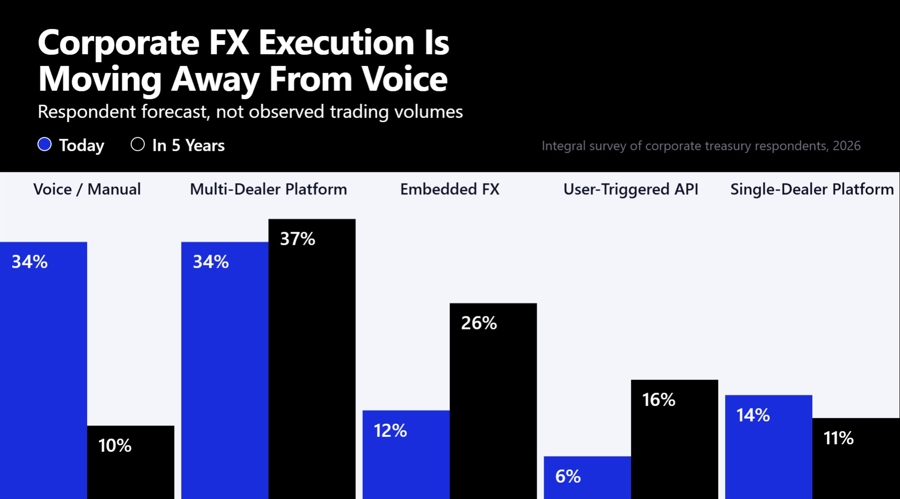
Treasurers expect voice trading to fall from 34% to 10% of their foreign exchange mix within five years, an Integral survey released today (Wednesday) found. Embedded and user-triggered API execution is forecast to reach 42%, up from 18%.
The same respondents identified a readiness gap that could slow that change. Eighty-three percent of corporate treasurers reported at least one barrier to automation, while only 19% of the sell-side group said it had predictive analytics.
The Integral survey report combines responses from 67 corporate treasury participants and 76 banks and other financial institutions. Of the 143 submitted datasets, 103 were complete.
Integral describes the execution figures as normalized channel shares. The report does not say whether they are simple averages of respondent allocations or weighted by actual trading volume.
Voice Gives Up 24 Percentage Points
Voice and manual execution tied with multi-dealer platforms as the main corporate channels today, each with a 34% share. Respondents expect the multi-dealer share to edge up to 37%, even as voice falls by 24 percentage points.
Embedded execution inside enterprise resource planning and treasury management systems is projected to rise from 12% to 26%. User-triggered API trading is expected to increase from 6% to 16%, while single-dealer platforms slip from 14% to 11%.
Integral has been adding connections that fit this model. Its clients gained direct access to CME Group’s EBS Market and FX Spot+ through existing interfaces, APIs and algorithmic models in 2025.
The company has also expanded the distribution side of its network. Lloyds joined as a liquidity provider in July, giving the bank a channel for streaming prices to Integral clients.
Corporate Systems and Bank APIs Create Different Barriers
Large corporates and multinationals most often blamed their own technology. Fifty-six percent cited legacy systems, fragmented domestic infrastructure and complex treasury technology as obstacles to importing real-time API feeds.
Among mid-market and growth companies, 43% pointed instead to bank API readiness. The respondents cited complex and non-standardized integration requirements that smaller treasury teams may lack the resources to implement.
A separate PwC survey of 350 treasurers found that 65% planned to expand API use, while 36% still used manual processes for FX exposure management.
[#highlighted-links#]
“Banks have a crucial role to play,” Integral Chief Executive Officer Harpal Sandhu said. He added that banks would need API-first platforms that connect with corporate systems and can support AI agents.
Integral has sold that type of infrastructure to banks including Hungary’s OTP Group, which adopted its aggregation, pricing, trading and risk tools in 2024.
Access Bank Nigeria added Integral’s distribution technology last year for its own operations and white-label services.
The report’s sell-side sample was broader than banks alone. Tier-two and tier-three banks made up 64%, institutional brokers accounted for 15%, non-bank market makers represented 5% and other financial companies comprised the remaining 16%.
Question-level sample sizes are not disclosed. Fieldwork dates are also absent.
The geographic breakdown applies to the sell-side group, where 37% of participants were in Asia, 27% in Europe and 4% in North America.
Trading Technology Is Moving Toward Common Interfaces
Other infrastructure providers have been reducing the number of separate connections institutions must maintain. Wells Fargo adopted TransFICC’s One API to connect its fixed-income systems with seven electronic venues through a normalized format.
In FX swaps, 360T introduced API-based mid-market streaming on its Swap User Network with Deutsche Bank and ING in 2023. The system supports aggregation, auto-hedging and algorithmic execution.
Technology vendors are also automating decisions around liquidity. oneZero’s Liquidity Hub added auto-hedging, quote filtering and automated session controls as far back as 2018.
AI Expectations Run Ahead of Deployment
Only 8% of corporate respondents said they were running active AI pilots in treasury. Another 67% remained in the monitoring or conceptual stage, but half expected autonomous agents to handle more than one-quarter of their FX workflow within five years.
On the sell side, 60% said AI would have the greatest impact on distribution strategies. Another 49% identified agentic AI among the technologies likely to matter most.
Current data capabilities were less advanced. Fifty-four percent reported real-time data ingestion, 27% remained limited to historical reporting and 19% had predictive models.
The adoption gap extends beyond FX. European financial firms keep most reported AI applications inside their organizations, according to a recent review of European Securities and Markets Authority data.
Corporate respondents also favored human approval for decisions that put capital at risk. They saw near-term uses for AI in checking exposure data, improving internal netting and preparing transactions within limits set by the treasurer.
If FX execution became largely automated and embedded, 65% said they would redirect resources toward risk management. Another 29% selected liquidity optimization in a multiple-choice question where responses could exceed 100%.
This article was written by Damian Chmiel at www.financemagnates.com.Institutional FXRead More
You might also be interested in reading Thailand SEC proposes retail access to regulated overseas crypto derivatives.