


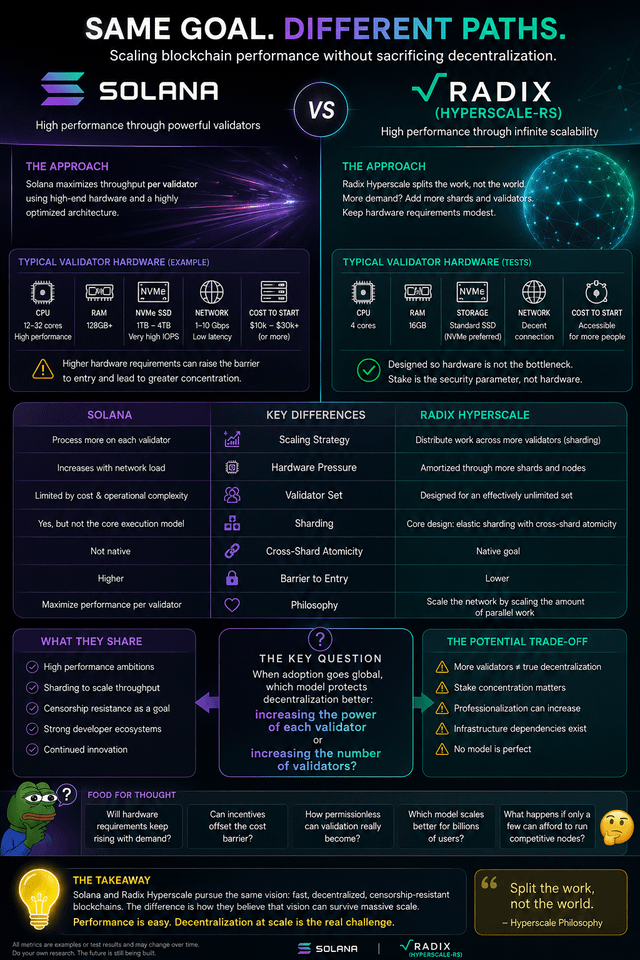
But their approaches are quite different.
Solana pushes extremely high performance through aggressive optimization and powerful validator hardware.
That can be a very effective way to scale, but it raises an interesting question: if hardware requirements keep increasing as adoption grows, does that eventually create a higher barrier to becoming a validator.
Radix is taking a different approach with Hyperscale-rs: instead of continually asking each validator to do more work, the architecture aims to distribute the workload across more shards and validators. Public testing has demonstrated very high throughput using relatively modest hardware.
This doesn’t automatically mean “Radix is more decentralized” or “Solana is centralized.” Validator count alone doesn’t determine decentralization — stake distribution, operator independence, infrastructure concentration and the actual cost of participation all matter.
The more interesting question, in my opinion, is:
When billions of users arrive, which model scales decentralization better — making each validator more powerful, or increasing the number of validators sharing the work?
And perhaps the biggest question:
Can a blockchain remain truly permissionless if running a competitive validator eventually requires professional-grade infrastructure.
Curious to hear how Solana and Radix supporters see this trade-off.
submitted by /u/CellistBasic2195 [link] [comments]
r/CryptoCurrencyRead More
You might also be interested in reading EQS-PVR: Gerresheimer AG: Release according to Article 40, Section 1 of the WpHG [the German Securities Trading Act] with the objective of Europe-wide distribution.