


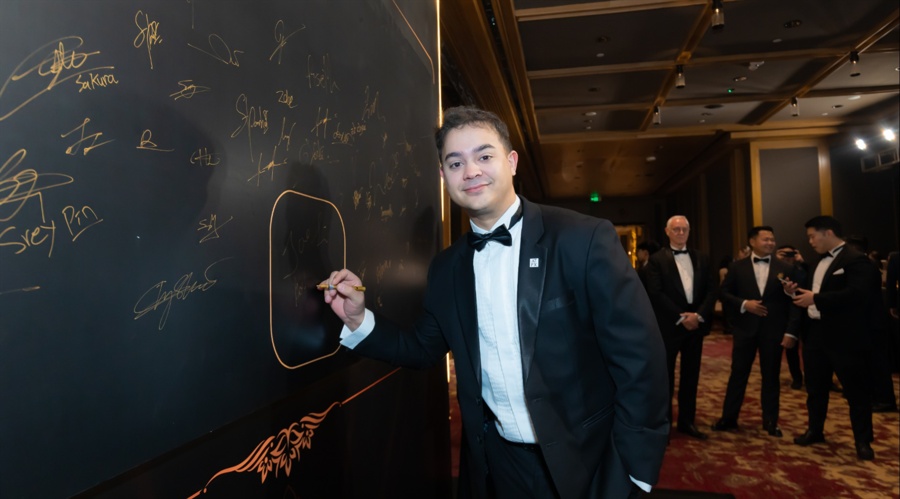
If your LinkedIn feed is tuned to the trading industry, ATFX Cambodia was hard to miss recently: a first anniversary, a new Phnom Penh branch opening attended by government officials, and a No. 1 ranking by trading volume from the local regulator for May 2026.
So we sat down with Alexander Lessells, CEO of ATFX Cambodia, to understand how the local market actually works, what the brand plans there, and where a frontier office fits into a group that operates across 24 locations worldwide.
Six Months If You’re Lucky
Cambodia is not a market you enter casually. A derivatives license from the Securities and Exchange Regulator of Cambodia (SERC) took ATFX through a process Lessells describes as rigorous at every step, with the National Bank of Cambodia adding its own strict guidelines on top.
“You’d be very, very lucky to hit six months to get up and running,” he says of the timeline from first filing to operative license, “and that’s without rushing.”
The capital side is just as demanding. “Your minimum investment into Cambodia to get this licence would probably be a million dollars,” Lessells says, and that figure excludes compliance, finance, HR and sales staff. “It sounds like a nice round number, but there are many unforeseen costs that increase it up quite a bit.”
The regulator’s attention does not stop at onboarding. Every product on the shelf needs SERC approval, marketing must carry clear risk warnings, and guaranteed returns are off the table. Even rolling out MT5 initially raised eyebrows at the regulator, which wanted to be certain a new platform was not an unlicensed shop trading under the ATFX Cambodia name.
The payoff, in Lessells’ telling, is that the license became the company’s strongest marketing asset. “A lot of our clients understand that we are licensed, but they don’t understand the scrutiny we’ve gone through to get this license. We definitely use it as a marketing tool.”
A Market That Wants to See Your Face
That scrutiny matters because Cambodian clients, unusually for the region, actively check it. Lessells says clients ask about local licensing when choosing a broker, and ATFX leans into it as the differentiator against offshore operators serving the market remotely.
The market itself is small, young, and almost entirely retail. Deposits range from $20 or $50 up to around $1,000, which rules out the mass-marketing playbook used elsewhere in Southeast Asia.
Acquisition instead runs on education and physical presence.
ATFX Cambodia holds seminars two to three times a week, hosts around 20 clients at its office twice weekly, and runs webinars that draw anywhere from 25 to 60 prospective clients, alongside local introducing partners and plenty of word of mouth.
“The clientele in Cambodia is a very one-to-one relationship,” Lessells explains. “They want to see your face. They want to come to your office. They want to get to know the company.”
On instruments, the picture is clear: FX and gold lead, with indices a distant third among more experienced traders.
Gold carries particular weight, Lessells notes, as a store of value woven into Cambodian life from shops to weddings. There is curiosity around crypto-linked products, but everything waits on SERC approval, and he hints that new products are coming soon.
The group is finishing an AI-driven central platform, internally called the AT Hub, that will handle lead management, client inquiries and live chat across all regions, Cambodia included.
We understand the system is roughly 80% built and in testing ahead of the regional rollout. How quickly an AI layer gets adopted in a market where clients prefer to walk into the office will be a genuinely interesting test case.
Not a Sales Office
ATFX Cambodia currently employs around 50 and is growing.
Lessells, is keen to stress this is a full standalone operation rather than a sales outpost: licensing and compliance, risk management, dealing, operations, IT, marketing and a customer service desk that runs 24/7, all serving the domestic market exclusively under the SERC licence.
Which raises the obvious question: how do you scale a one-to-one, meet-every-client model on Cambodian deposit sizes?
Lessells’ answer is that you don’t try to automate it away, you staff for it. “I actually encourage my staff to meet the clients, or definitely bring them to the office. We have nothing to hide, and clients love to see us.”
There are no aggressive monthly targets on the local teams, he says. The stated priority is education and controlled growth, on the logic that growing too fast in a market this early carries its own risk.
The Institutional Question
The next chapter is institutional. ATFX is working with SERC on potentially bringing ATFX Connect, the group’s institutional liquidity arm, into the local market.
Lessells is careful not to overpromise on timing. “We’ve been here just over a year. We’re growing gradually. We’re not trying to light our feet on fire and jump into the water.”
Hiring, the Cambodian Way
Ask Lessells what actually makes the office work and he talks less about products and more about culture.
Cambodia is a family-driven country with deep respect for elders, he says, and the management team runs the office on the same principle: juniors are treated as family and held accountable in equal measure.
“I don’t want to give away the secret sauce”, he says, “but we don’t hire and fire”. One of his top salespeople was hired from a bakery, with no FX experience at all, and grew to become a top performer.
“We trained her, we guided her. It’s down to the guidance, and what she looks for in the next five years within a company.”
Lessells himself is half British, half Caribbean, and has lived in China, London and the United States. “Being in Cambodia, I’ve never felt more at home anywhere else in the world,” he says. “I can see where the next 30, 40 years will be, and I’m very happy to be part of that journey.”
His most memorable moment of the year had nothing to do with the markets, though.
Earlier this year, ATFX flew the entire Cambodia team, down to the cleaner, to the group’s annual gala in Korea. Many of the team had never been on a plane or left the country before, and the office, which has a reputation inside the group as one of its liveliest and most tightly knit, turned up as one of the top performers.
They did not, however, win the dancing competition. “The Philippines beats us,” Lessells concedes, “they always win.”
This article was written by Jonathan Fine at www.financemagnates.com.Retail FXRead More
You might also be interested in reading IOTA: The New Competitive Advantage… Is Not Competing?.